The Blueprint for Context-Aware Retrieval: From Knowledge Graph to Semantic ID
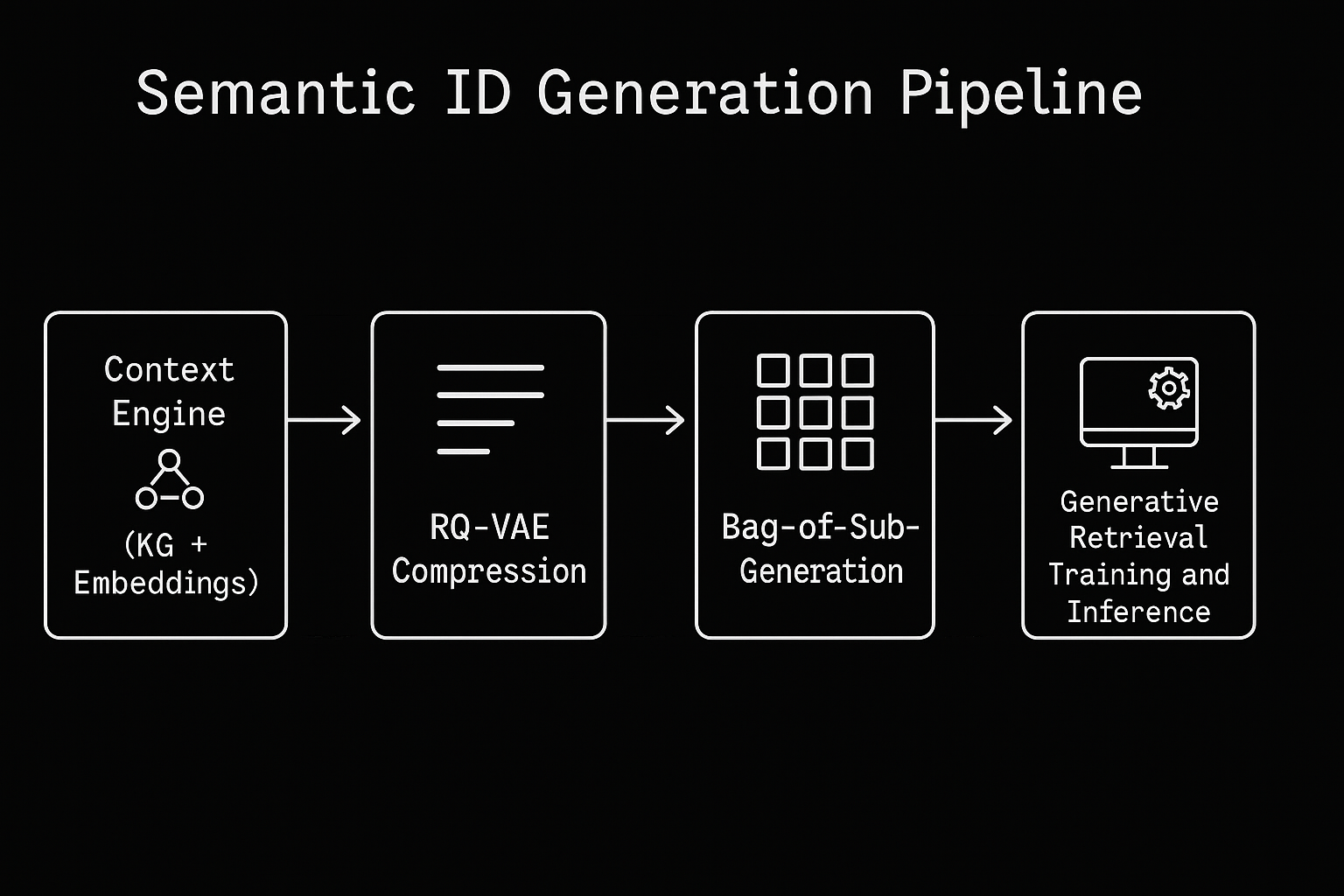
The Blueprint for Context-Aware Retrieval: From Knowledge Graph to Semantic ID
Recent developments in AI systems have revealed a limitation: traditional retrieval methods just aren’t cutting it anymore. Those old approaches based on static embeddings and nearest-neighbor search? They’re hitting a wall when it comes to the sophisticated, context-aware applications that modern AI agents need to handle.
Recent research has fundamentally reshaped approaches to storing and retrieving information, representing a fundamental shift in recommendation systems, memory architectures, and generative AI applications.
What really caught my attention is this comprehensive paradigm shift from classical vector retrieval to semantic ID-based generative systems. The research I’ll be walking you through includes some breakthrough work like the TIGER framework (Rajput et al., 2024), YouTube’s incredible advances in generative video retrieval (Wang et al., 2024), and some really clever stuff with contextual graph representations through CARTE (Liu et al., 2024) and KumoRFM (KumoRFM) architectures.
This convergence represents three major research directions converge:
Structured Contextual Representations: Consider how CARTE handles context-aware table processing, or how PyTorch Geometric scales graph neural networks. This approach transforms structured data into rich, relational knowledge graphs that actually capture business logic and domain expertise.
Semantic ID Compression: This is where things get really interesting. The TIGER research pioneered this approach where dense embeddings get compressed into discrete, hierarchical codewords using RQ-VAE (Residual Quantization Vector-Quantized Autoencoders). It’s like creating interpretable “semantic addresses” for entities.
Generative Retrieval Paradigms: Instead of just searching for stuff, systems are evolving that generate what they need. Transformer models learn to predict the semantic IDs of relevant items directly, which solves cold-start problems and makes everything more explainable.
This blueprint covers both the theory and practical implementation strategies for building next-generation retrieval systems. These can scale to millions of multimodal entities while keeping semantic coherence and business context awareness intact.
Table of Contents
- Foundation: Modern Multimodal Embedding Models
- Data Processing: Chunking Strategies for Multimodal Content
- Structured vs Unstructured Data Processing
- Deep Dive: CARTE vs PyTorch Geometric
- Context-Aware Memory Systems
- Agentic Applications and Context Engineering
- Context Engineering in Structured Environments
- Sequential Data and Unstructured Approaches
- The Paradigm Shift: Semantic IDs and Generative Retrieval
- Modern Contextual Semantic ID Pipeline
- Evolution: From Embedding Search to Generative Retrieval
- Implementation: Production-Ready Semantic ID Pipeline
- Conclusion
- References
I want to start by breaking down the current state-of-the-art in multimodal embedding models for image, text, and audio. Understanding how these models chunk and create embeddings from unstructured data is crucial before we dive into the more complex knowledge graph systems and GNNs.
Foundation: Modern Multimodal Embedding Models
Key Models
- CLIP (OpenAI)
- Predecessor, still influential: Excels at aligning images with text by mapping both into a shared embedding space, enabling zero-shot and retrieval tasks.
- ImageBind (Meta AI)
- The multi-modal powerhouse: This model embeds six different modalities (text, image, audio, video, depth, and IMU) into a unified vector space. This capability enables cross-modal search and reasoning. This enables retrieving an image using an audio query or vice versa.
- Cohere Embed 4
- Enterprise-grade: Processes text, image, and (recently) audio natively for robust retrieval and agentic use-cases. Supports high-quality chunking and joint embedding, optimized for scale and contextual semantics[1][2][3].
- Nomic Embed Multimodal
- Open-source and growing fast: This one’s designed specifically for embedding “visual documents” like PDFs, charts, and images. It delivers state-of-the-art cross-modal retrieval and is surprisingly efficient for large-scale tasks[4][5].
- VLM2Vec(V2)
- The unified approach: Trained on the MMEB-V2 benchmark, this model supports text, image, video, and even visual documents. What impressed me is how it outperforms earlier models for both in-distribution and out-of-distribution generalization[6][7].
- Titan Multimodal Embeddings (AWS)
- Production-oriented: Jointly embeds image and text into a tightly aligned space, using “curated” data to minimize train/test mismatch and optimize for retrieval latency[8].
- WhisBERT
- Text-audio fusion: Inspired by Whisper, combines BERT-style text models with speech/audio representations, highlighting growing focus on joint audio-text embeddings[9].
Data Processing: Chunking Strategies for Multimodal Content
The Goal:
Chunking is essentially the process of breaking large, unstructured, multi-modal content into “meaningful units” (chunks) that can be efficiently and contextually embedded, retrieved, and reasoned over. It sounds simple, but getting it right makes all the difference.
Techniques
- Segmentation-based Chunking
- For text: split into sentences, paragraphs, or thematically-coherent blocks.
- For images: chunk at the object, frame, or scene level.
- For audio: segment by utterances, time windows, or natural pauses.
- For video: split by shots or scene transitions[10][11].
- Hierarchical Chunking
- Use nested chunks (e.g., paragraph inside section for text, frame inside scene for video), supporting retrieval at different granularity[12].
- Content-aware/Thematic Chunking
- This approach uses semantic analysis (NLP, scene analysis) to chunk based on meaning rather than just size. It’s particularly important for capturing coherent concepts across modalities[10].
- Fixed-size Chunking
- This is simpler but widely used. You just divide content into N tokens, N seconds, or N pixels per chunk. It ensures compatibility with model context limits but can disrupt semantic boundaries[13].
- Model-guided/Recursive Character Level
- Break down using a cascade of separators (paragraph, sentence, word) until reaching a token limit, ensuring chunks are as semantically whole as possible[13].
Multimodal Adaptation
Each chunk might comprise a tuple like (text, image, audio) and gets processed by modality-specific encoders. The real trick is synchronizing these modalities. For example, alignment requires transcript text with the corresponding video frame and audio segment, then jointly embed them via a model like ImageBind or Cohere Embed 4[14][15].
How SOTA Multimodal Models Generate Embeddings
- Encoders per Modality
- Text encoders: Usually Transformer-based (BERT, GPT-like).
- Image encoders: Vision transformers (ViT), CNNs.
- Audio encoders: Wav2Vec(2), Whisper (for speech), or spectrogram-based CNNs[15].
- Fusion Strategies
- Early Fusion: Concatenate raw features, then encode jointly.
- Late Fusion: Encode each modality independently, then combine in the latent space.
- Hybrid/Intermediate Fusion: Multiple fusion points, sometimes using attention mechanisms, to align and integrate information contextually[15].
Here’s what this looks like in practice:
Imagine a chunked segment from a customer support conversation:
- [Text]: “My order arrived damaged.”
- [Image]: Photo of damaged item.
- [Audio]: Brief voicemail from the customer.
Each gets encoded, then the embeddings are merged or projected into a shared latent space, forming a multimodal embedding that supports semantic search, retrieval, and graph construction.
Summary Table: Selected SOTA Models & Capabilities
| Model | Modalities Supported | Typical Use Cases | Notable Features |
|---|---|---|---|
| CLIP | Text, Image | Search, captioning, retrieval | Open-source, extensible |
| ImageBind | Text, Image, Audio, etc. | Cross-modal retrieval & generation | Six modalities, alignment ability |
| Cohere Embed 4 | Text, Image, Audio | Retrieval-augmented generation, search | Hierarchical chunking, fast, SOTA |
| VLM2Vec(V2) | Text, Image, Video, Doc | Video/image/text search, RAG | Universal chunking, instruction-aware |
| Titan Multimodal | Text, Image | Fast production retrieval | Latency-optimized, curated data |
| Nomic Embed | Text, Image, Charts | Large document/image search | Document-focused, open-source |
| WhisBERT | Text, Audio | ASR, audio-text retrieval | Whisper/BERT fusion |
[References: [1][2][3][4][5][6][7]]
Bottom line:
State-of-the-art multimodal embedding models enable AI to chunk and embed image, text, audio, and more, making raw, unstructured data addressable for downstream reasoning, retrieval, and graph-based workflows. The next step is understanding how these embeddings are used as features in graph neural networks (GNNs) to build knowledge graphs with node and edge embeddings for unified, scalable, multi-modal memory and reasoning.
The role of PyTorch Geometric (PyG), models like CARTE, and PyTorch Frame when handling structured versus unstructured data, specifically for multimodal data (text, images, audio, video):
Structured vs Unstructured Data Processing
Unstructured vs. Structured Data
Unstructured Data
- Definition: Raw content with little inherent structure—text documents, audio streams, images, and video files.
- Typical Tasks: Classification, retrieval, captioning, summarization, search.
- How Multimodal Embedding Models Fit:
- Models like CLIP, ImageBind, and multimodal transformers take unstructured input—text, an image, an audio clip, or a video frame—and turn each “chunk” or sample into a dense vector (embedding). These vectors make large-scale search, clustering, and retrieval across modalities possible (e.g., “find pictures related to this audio query”)[1][2][3].
Structured Data
- Definition: Data organized into rows/columns (tables) or with explicit relationships between entities (customer-table, order-table, product-table), often modeled as graphs.
- Typical Tasks: Prediction, recommendation, entity linking, root-cause analysis, complex retrieval.
- How Graph-Based Models Fit:
- Models like CARTE and standard PyG-based GNNs excel here. Each row or entity is a node, relationships are edges, and features can include text, image, audio, or video embeddings[4][5][6][7].
Where Do CARTE and PyG Models Come In?
CARTE (Context Aware Representation of Table Entries)
- Purpose: Bridge the gap for structured tabular/relational data, including multi-modal fields.
- How It Works:
- Table to Graphlet: Every row of a table is represented as a star graph (graphlet)—the center node for the target entry, edge nodes for each column value, and edges labeled by column.
- Multi-modality: Each node (text value, number, image URI, audio/video link) gets an embedding. Text is encoded via language models; images, audio, and video can use specialized encoders (e.g., CLIP, Wav2Vec, Video-BERT)[5][6].
- Edge Features: Edge types encode column semantics (so “age” vs. “diagnosis” edges are distinct).
- Graph Attention Transformer: CARTE uses graph transformers—attention is computed across nodes/edges, learning context within and across tables (even with different schemas)[5][8][7].
- Why Powerful: It enables pretraining/transfer learning for heterogeneous tables; different data types and columns can be harmonized and leveraged together.
PyTorch Geometric (PyG)-based GNNs
- Purpose: General toolkit for building and training graph neural networks over any structured, interconnected data.
- How It Works:
- Flexible Input: Supports arbitrary graphs—social networks, molecules, knowledge graphs, etc. Each node and edge can have custom features, including multimodal vector representations[4][9][10].
- Multi-modal Features: This approach allows attaching any embedding (e.g., from CLIP or other SOTA models) as a feature on a node, regardless of whether it represents text, image, audio, or video.
- Aggregation/Propagation: GNN layers (GCN, GAT, GraphSAGE, etc.) allow nodes to “learn” from their neighbors—contextualizing not just by connectivity but also feature similarity.
- Custom Graphs: PyG can handle complex scenarios—tables with media blobs, citation graphs, IoT device networks—scaling well across millions of nodes/edges[11][12].
How Multi-Modality Is Handled
- Node/Edge Embeddings: For every sample (row, entity, media asset), you create modality-specific embeddings:
- Text: Language models (BERT, T5, etc.)
- Image: Vision transformers (CLIP, ViT)
- Audio: Audio embedding models (Wav2Vec, CLAP)
- Video: Video encoders (Video-BERT, TimeSformer)
- These vectors are attached as node or edge features in the graph models (PyG or CARTE)[5][1][2][3].
- Unified Downstream Modeling: GNN layers (in PyG, or CARTE’s custom graph transformer) learn to blend these modalities using context and relationships—enabling complex reasoning and search.
Where to Use Each Approach?
| Task Type | Data | Architecture to Use | Example Scenario |
|---|---|---|---|
| Unstructured | Images, audio, text | Multimodal embedding models (CLIP, etc.) | Image/text search, audio classification |
| Structured | Tables, graphs | CARTE, PyG-based GNNs with multi-modality | Sales prediction using tables with images/audio |
| Hybrid | Both types | PyG (custom graph + multimodal features) | Knowledge graph with medical images + lab reports |
Key Takeaways
- CARTE is a model that turns tabular (often structured, multi-modal) data into graphlets, encodes node and edge context (including multi-modal embeddings), and enables learning across diverse tables and modalities[5][6][7].
- PyG is a framework for building custom GNNs over any structured data, allowing you to attach and process multi-modal embeddings as needed[4][10][11].
- Both approaches let you combine text, image, audio, and video vectors at the graph/network level—so systems can reason and retrieve across all modalities, not just within separate silos.
In agentic AI, this combination is why structured + multimodal memory (KG + vector store) is so potent: one can search, traverse, and reason across your entire data universe—finding meaning that spans tables, metadata, and every modality[5][1][2][3].
The Core Concept - Semantic IDs
Here’s where things get really interesting. At its heart, the problem with traditional recommender systems is that they treat items as abstract, meaningless identifiers.
The Traditional Way: An item, like a specific pair of running shoes, gets represented by a random ID — something like ItemID: 84391. This ID has zero inherent meaning. The model only learns about this item by watching user interactions with it. And that leads to the classic “cold-start” problem: if an item is new or has few interactions, the model knows nothing about it and can’t recommend it.
The Semantic ID Way: The goal here is to give every item a meaningful ID based on its actual properties (its “semantics”). Instead of a random number, the ID becomes a short sequence of tokens that describes the item’s position in a “semantic universe.”
The following example from the TIGER paper, “Recommender Systems with Generative Retrieval.”
Example: Creating a Semantic ID for a “Blue Running Shoe”
- Content Features: We start with the item’s raw data:
- Title: “Men’s CloudRunner Shoe”
- Brand: “On”
- Category: “Running Shoes”
- Color: “Midnight Blue”
- Description: “A cushioned, supportive running shoe for everyday runs…”
Content Embedding: We feed this text into a powerful, pre-trained text encoder (like Sentence-T5). This model understands language and converts all that information into a dense numerical vector (an embedding) that captures the item’s meaning.
- Embedding Vector: [0.81, -0.25, 0.55, …] (a long list of numbers)
Quantization (The Magic Step): This is where the RQ-VAE model comes in. It takes that rich embedding vector and “quantizes” it — compressing it into a short, structured sequence of discrete tokens. Think of it like creating a hierarchical address for the item.
- The RQ-VAE learns a set of “codebooks.” The first codebook might represent broad categories, the second one sub-categories, and so on.
- It finds the best token from each codebook to represent the item at different levels of granularity.
- The result is our Semantic ID: (5, 25, 55)
Notably, 5 might represent “Footwear,” 25 might represent “Athletic Footwear,” and 55 could represent “Cushioned Running Shoe.” A different blue running shoe might have the ID (5, 25, 56). A blue hiking shoe might be (5, 26, 12). This structure immediately reveals they share a partial ID, showing they’re related.
Building the Recommender with Generative Retrieval
Now that every item has a meaningful ID, we can build the recommender system. This is where everything comes together.
The TIGER Framework (Generative Retrieval)
This paper introduces the paradigm shift. Instead of trying to match a user’s profile to item embeddings, we train a model to generate the next item’s Semantic ID, token by token.
Example: Predicting the Next Item
User History: We look at the sequence of items a user has interacted with, but we represent them by their Semantic IDs.
- User bought: “Red Hiking Boots” -> (5, 26, 11)
- User viewed: “Trail Running Shoes” -> (5, 25, 78)
- User liked: “Blue Running Shoes” -> (5, 25, 55)
Model Input: We feed this sequence of tokens into a Transformer model (like the one used in GPT). The input is literally the sequence: 5, 26, 11, 5, 25, 78, 5, 25, 55.
The Generative Task: We train the Transformer to predict the most likely next sequence of tokens. Based on the user’s history of liking running and trail shoes, the model might predict:
- First token: 5 (It’s likely another piece of “Footwear”)
- Second token: 25 (Probably “Athletic”)
- Third token: 56 (A new, but related, “Running Shoe”)
The Recommendation: The model has generated a new Semantic ID: (5, 25, 56). We then do a simple lookup in our database: “Which item has this ID?” and we find, for example, “Women’s CloudSurfer Shoe”. We can then recommend this item.
“Better Generalization” (Making it Practical)
The second paper addresses how to make this work on a massive, real-world scale like YouTube. It recognizes that treating the full ID (5, 25, 55) as a single, atomic unit can be too rigid.
Their key insight? Treat the Semantic ID as a “sentence” and break it into smaller “subwords” or n-grams.
- Unigrams: The model can learn from the individual tokens: (5), (25), (55). This allows it to learn that a user liking items with (5) in their ID is interested in footwear in general.
- Bigrams: It can also learn from pairs: (5, 25) and (25, 55). This captures more specific relationships, like “Athletic Footwear.”
This approach gives the model flexibility. It can make recommendations based on broad category matches or very specific sub-category matches, which improves generalization to new and long-tail items while still retaining the power of memorizing popular patterns.
Better Generalization with Semantic IDs: A Case Study
Core Problem: The authors wanted to replace traditional, meaningless random IDs (like video_ID_ABC123) in a massive, production-level recommender system (YouTube) with meaningful, content-derived Semantic IDs. They discovered it’s not a simple swap. Production models are heavily optimized for memorization—they are very good at learning “users who like X also like Y” for popular items. Simply replacing random IDs with content embeddings or basic Semantic IDs improved recommendations for new and niche (“long-tail”) items but hurt performance on the most popular (“head”) items, because this raw memorization ability was weakened.
The Goal: Find a way to get the best of both worlds: the generalization of semantics (to recommend new and long-tail items) and the memorization of a traditional ID-based system (to maintain performance on popular items).
The Solution: The key insight was to treat the Semantic ID not as a single, atomic block, but as a sequence of smaller, learnable pieces. They proposed two main techniques for breaking down the Semantic ID sequence into “subwords”:
- N-grams: A straightforward method of creating embeddings for every individual token (unigram), every pair of tokens (bigram), etc., within the Semantic ID. This allows the model to learn relationships at different levels of granularity.
- SentencePiece Model (SPM): A more advanced, data-driven approach borrowed from language models. SPM analyzes all the Semantic IDs in the catalog and learns the most statistically significant “subwords” of variable lengths. For example, it might learn that a specific 3-token sequence appears so often that it should be treated as its own unique subword.
The Outcome: By representing items as a “bag of subwords” derived from their Semantic IDs, they successfully replaced the old random ID system. This new approach improved generalization and cold-start performance on new and long-tail videos without sacrificing the overall quality and performance of the ranking model.
Part 2: Summary in the Context of Your Project (with Examples)
This paper is essentially the “how-to” guide for the final, most important step of our hybrid approach. This discussion has already covered generating a synthetic catalog and training an RQ-VAE to create high-quality Semantic IDs. This paper tells you what to do with those IDs to make them effective in a real system for your client.
Consider a concrete example from your client’s (hypothetical) e-commerce site for outdoor gear.
The Scenario: Your client has a new, niche item: “Arctic Tern Waterproof 4-Season Tent”. Using our hybrid approach, this tent gets a Semantic ID, assume: (10, 4, 92, 15)
10 = “Shelter”
4 = “Tents”
92 = “4-Season / Mountaineering”
15 = “Waterproof”
The Problem this Paper Solves:
If we just train the recommender to predict the full ID (10, 4, 92, 15), it’s too rigid. The model only learns about this exact tent when users interact with it.
However, consider a user who has never seen this tent, but their history looks like this:
- Bought a “Down-filled Winter Sleeping Bag” -> Semantic ID: (12, 8, 92, 30)
- Viewed a “3-Season Backpacking Tent” -> Semantic ID: (10, 4, 91, 5)
A traditional system would struggle to connect this history to the new tent. This is where the paper’s solution becomes critical.
Applying the Paper’s Solution (The “Bag of Subwords” approach):
Instead of treating (10, 4, 92, 15) as one thing, your model breaks it down and learns from the pieces:
- Unigrams: (10), (4), (92), (15)
- Bigrams: (10, 4), (4, 92), (92, 15)
Examining the user’s history through this new lens:
- The user’s purchase of the sleeping bag has the token (92) (“4-Season / Mountaineering”).
- The user’s view of the other tent has the bigram (10, 4) (“Shelter, Tents”).
The recommendation model can now reason as follows: “This user has shown interest in things that are (92) and things that are (10, 4). I should find an item that contains both of these signals.”
It searches for items that have the (92) unigram and the (10, 4) bigram in their “bag of subwords.” Your new “Arctic Tern Waterproof 4-Season Tent” is a perfect match.
The recommendation is made.
This is where it gets really exciting. The system just recommended a brand-new item to a user who had never seen it, based on a shared semantic understanding of its components. It connected the user’s interest in “tents” from one item and “4-season gear” from another. This is literally impossible with random IDs and represents the core value that these systems can deliver.
This section examines how CARTE builds multimodal graphlet representations from table data, keeps modality connections intact, and how GNNs (including CARTE and generic PyG models) actually blend multi-modal node features for context-aware inference.
How CARTE Handles Multi-Modality and Preserves Connections
I find CARTE’s approach particularly elegant. It transforms each row of a (potentially multimodal) table into a star-shaped graphlet:
- Central node: Represents the row (the main “entity”).
- Leaf nodes: One for each column value (could be text, number, image URI, audio link, etc.).
- Edges: Labeled with the column name/type, connect the central node to each feature node.
Let’s use a concrete example:
| User  | Age | ProfilePic           | VoiceNote              |
|-------|-----|----------------------|------------------------|
| Alice | 31  | alice.jpg            | alice_intro.wav        |
| Bob   | 22  | bob.jpg              | bob_greeting.wav       |
For Alice’s row:
- Central node:
r_Alice - Leaf nodes:
v_User: Alice(text)v_Age: 31(number)v_ProfilePic: alice.jpgv_VoiceNote: alice_intro.wav
Key steps:
Modality-specific encoding:
- Text/number: Use a language model or numerical encoder.
- Image: Use CLIP or ViT to produce a vector for the image file.
- Audio: Use Wav2Vec or a similar model for an audio clip.
- Each value node gets a feature vector representing its modality/content.
Edge typing:
- Each edge is labeled/type-aware (e.g., “ProfilePic”, “VoiceNote”)—the model knows what kind of data connects the nodes.
Preserving connections:
- The structure of the graphlet (edges + edge types) means every embedding from non-text modalities is “anchored” to the correct row and semantic role—
alice.jpgis only ever considered as Alice’s profile pic.
- The structure of the graphlet (edges + edge types) means every embedding from non-text modalities is “anchored” to the correct row and semantic role—
Contextual graph encoding:
- These graphlets are fed into a graph transformer (attention-based GNN).
- Attention layers update each node embedding by attending to all neighbors—but with awareness of edge types and neighbor features.
Result:
- The final embedding for Alice’s row is a contextually-blended vector, aware of:
- Her name, age, profile picture (visual), and voice intro (audio),
- How these are interconnected for this row.
- This representation is leveraged for downstream tasks, transfer learning, and retrieval—all without losing which image/audio belongs to which user.
Let’s rigorously break down how generic GNNs, specifically with PyTorch Geometric (PyG) and PyTorch Frame, handle node and edge features for multimodal, structured data (e.g., text, image, audio), and contrast this with the CARTE method. This will focus on practical graph construction, feature initialization, aggregation in GNN layers, and the treatment of edge features.
1. Building a Multimodal Graph with PyG & PyTorch Frame
PyG (with or without PyTorch Frame) is extremely flexible for real-world, multimodal, and heterogeneous tabular or knowledge-graph data. Here’s a deep, step-by-step process:
A. Graph Construction—Semantic Mapping to Nodes and Edges
Step 1: Define Nodes
- Each entity becomes a node in your graph. Entities can be:
- Row-based: Each table row (e.g., a user) is a node.
- Type-based: Product, category, event, etc.
- Node IDs are numerically indexed (e.g., user Alice is node 0).
Step 2: Define Edges
- Relationships form edges:
- Purchase, friendship, click, foreign-key, etc.
- Each edge is directed or undirected and optionally typed.
- Edge index matrix (
edge_index): a 2×N matrix listing [source, target] pairs.
Step 3: Attach Node Features (Multimodal)
Each node can have a feature vector—this is where multimodality shines:
- Text: Encode text columns using a text embedding model (BERT, etc.).
- Image: Use CLIP (or ViT) to convert images referenced by the node into vectors.
- Audio: Wav2Vec for audio files.
- Numeric/categorical: Standardize or one-hot encode scalars/categories.
Feature stacking: Concatenate or stack all desired embeddings per node, so for each node, the input is a single (potentially long) feature vector:
node_feature = [text_embed | image_embed | audio_embed | numeric]PyTorch Frame: This library modularizes the feature extraction and loading for heterogeneous tabular data (numerical, categorical, text, image, custom embeddings), so you don’t have to hand-code the extraction and stacking logic. It directly produces multimodal feature tensors for all columns and can integrate with GNN models[1].
Step 4: Attach Edge Features
- Edges can carry feature vectors too (often underused, but very important):
- Relationship type (e.g., “purchased on mobile” vs. “purchased in store”) can be one-hot or embedding.
- Time/weight: Timestamp, duration, or affinity score can be direct edge features.
- Media on edges: In knowledge graphs, sometimes the relationship (edge) itself can have an attached document, image, or even audio—for example, a “contract” edge with a scanned PDF.
- In PyG, edge features are attached as
edge_attr: a [num_edges, feature_size] tensor, with each row aligned to an edge inedge_index.
B. Core Data Structure in PyG
A graph is encoded as a torch_geometric.data.Data object:
from torch_geometric.data import Data

# Node features (N_nodes x feat_dim)
x = torch.tensor([...], dtype=torch.float)

# Edges (2 x N_edges)
edge_index = torch.tensor([[src1, src2, ...], [dst1, dst2, ...]], dtype=torch.long)

# Edge features (N_edges x edge_feat_dim)
edge_attr = torch.tensor([...], dtype=torch.float)

data = Data(x=x, edge_index=edge_index, edge_attr=edge_attr, y=...)- If there are no node features: Pass a placeholder (e.g., all ones or zeros).
- Node IDs map directly:
data.x[i]is the feature for node i. - Edge features:
data.edge_attr[j]is the feature for the edge atedge_index[:, j].
C. Node & Edge Feature Propagation—How GNNs “Blend” Modalities
Step 1: Message Passing Layer
Generic GNN layers (GCN, GAT, GraphSAGE, or your own) operate iteratively, updating each node’s embedding based on its neighbors and the relationships (edges) connecting them:
h_v^{(l+1)} = AGG(h_v^{(l)}, { f(h_v^{(l)}, h_u^{(l)}, e_{uv}) | u ∈ N(v) })Where:
h_v: Feature vector for node v, layer le_{uv}: Edge feature between u and vAGG: Aggregation function (e.g., sum, mean, attention)f: (optional) function blending own node feat, neighbor feat, edge feat
Step 2: Edge Feature Use
- In basic GNNs (GCN, GraphSAGE), edge features can be concatenated or transformed before aggregation.
- In more advanced variants (GATv2, edge-conditioned convolutions, relational GCN), relationship info modulates message weight.
- Example: For a “friendship strength” edge, edge features could upweight or downweight aggregation.
- Edge-aware attention: Each edge can have a unique attention score based on its features[2].
Step 3: Multi-Hop and Heterogeneous Graphs
- HeteroData in PyG allows different types of nodes (user, item, media) and edge types (purchased, viewed, listened-to), each with their feature templates[3].
- Message passing can be type- and feature-specific, and the framework will handle batching and correct neighbor aggregation.
D. Real Example (Multimodal KG for Multimedia Platform)
Suppose you’re building a social media graph:
- Nodes: Users, Posts, Media (images, audio, video)
- User feature: [username embedding, profile_pic embedding, numeric: age]
- Post feature: [post text embed, timestamp, attached image/video embedding]
- Media feature: [clip embedding]
- Edges:
- “posted,” “liked,” “commented_on” (with timestamp, device info as edge features)
- “friend” edges between User nodes with friendship strength, or even a “friendship_evidence” audio note (so edge has audio embedding)
In PyG:
- Each type of feature is computed and stacked per node and per edge, then all are efficiently encoded into tensors.
- During training, the message aggregation can distinguish not just from which node messages arrive, but over which edge type, and with which edge features and modalities.
2. PyTorch Frame: Modular Tabular Extension
PyTorch Frame simplifies feature engineering/mixing for tabular/multimodal data before you build your graph. It:
- Automatically detects and encodes column types (numerical, categorical, text, images, embeddings).
- Produces unified, per-row feature vectors (“row encoding”) for GNN input.
- Plays well with PyG: the output of a PyTorch Frame preprocessing pipeline slots directly into PyG’s
Data.xfor node features, with your own logic for forming the graph structure[1].
3. Contrast with CARTE (From the Paper)
| Generic PyG (or PyTorch Frame + PyG) | CARTE (Paper Model) | |
|---|---|---|
| Graph Construction | Full control: You define nodes, edges, types, structure. | Each row as a star-graph ‘graphlet’: central (entity) + features. |
| Modality-blending | Stack all available features per node; how features interact depends on your GNN architecture or aggregation. | Predefined attention-based transformer learns edge- and content-aware blending for each column and type. |
| Edge Features | Any (structured or unstructured): numeric, one-hot, text, multimedia embeddings. Used directly in message passing/aggregation. | Each edge (column) is typed and can inform transformer’s attention; often richer semantics for complex hetero-graphs. |
| Message Passing | Aggregation as designed: mean, attention, custom, using node+edge features. | Uses relational self-attention and custom positional encodings to focus on column types and structure. |
| Entity/context | Everything is parametrized and customizable, including graph topology and update rules. | Structure rigid: always one row = one graphlet, edges labeled by columns; optimal for tables. |
| Use Case Fit | General: Social graphs, KGs, recommendation, bioinformatics, etc. | Specialized for relational/tabular data tables + mixed modality columns. |
4. Summary: What PyG / PyTorch Frame Offer Over CARTE
- Generic Flexibility: With PyG (plus PyTorch Frame’s multimodal tabular engine), any graph can be built:
- Design your own topology, edge types, node/edge features, and feature mixing rules.
- Efficient, modular, and scalable for huge graphs and real-world settings[4][1].
- You choose how node and edge features interact: concatenation, neural transformation, edge-aware attention, etc.
- Contrast: CARTE is a high-level, opinionated GNN model for tabular/multimodal tables, best suited for direct table-to-graph conversion scenarios where column types and structure are paramount. It automates much of the engineering, but limits topological flexibility.
For complex, interconnected, multimodal data where relationships themselves matter and are richly featured, generic PyG (boosted by PyTorch Frame) is the best practice. For direct column/table modeling, CARTE is faster to deploy but less general. Both approaches use node and edge features at their foundation—but PyG provides full, granular control over how every modality is encoded and blended.
Context Engineered Agentic Flow in unstructured world
This section examines the memory architecture - specifically where and how embeddings are stored, when vector stores come into play, and how the complete system (CARTE vs PyTorch Frame + PyG) creates knowledge graphs that enable powerful context engineering for agentic applications.
Context-Aware Memory Systems
Memory Architecture: The Complete Picture
The final graph built by either CARTE or PyTorch Frame + PyG is indeed a Knowledge Graph (KG). But the complete memory system is actually a hybrid architecture that combines multiple storage layers:
1. The Knowledge Graph (Structural Memory)
- What it stores: Nodes (entities), edges (relationships), and their metadata
- Storage format: Graph databases like Neo4j, ArangoDB, or custom graph storage
- Example:
(Customer_Alice)-[PURCHASED]->(Order_123)-[CONTAINS]->(Product_Laptop)
2. The Vector Store (Semantic Memory)
- What it stores: Dense embeddings (vectors) for every node and edge in the KG
- Storage format: Vector databases like Pinecone, Weaviate, FAISS, or Chroma
- Purpose: Enable fast semantic similarity search across the entire graph
3. The Blob Storage (Raw Assets)
- What it stores: Actual multimodal files (images, audio, video, documents)
- Storage format: Object storage like S3, Azure Blob, or local file systems
- Connection: Referenced by URIs stored as node attributes in the KG
Deep Dive: CARTE vs PyTorch Geometric
CARTE vs PyTorch Frame + PyG: Memory Implementation Details
CARTE Approach: Integrated Memory
Graph Construction:
- Each table row becomes a star-shaped graphlet (central node + feature nodes)
- Node embeddings: Generated via CARTE’s graph transformer after contextual attention
- Storage strategy:
Graph DB: Stores graphlet structure + metadata
Vector Store: Stores final contextual embeddings from CARTE model
Blob Storage: Referenced media files from table columns
Memory Creation Process:
- Input: Tables with mixed columns (text, numbers, image URIs, audio files)
- Graphlet creation: Each row → star graph with typed edges
- Multimodal encoding: Each column value gets modality-specific embedding
- Contextual fusion: Graph transformer creates final node embeddings
- Storage: KG structure + contextual embeddings + raw assets
Embedding Storage:
# CARTE memory storage
carte_memory = {
    "knowledge_graph": neo4j_db,  # Graphlet structure
    "vector_store": pinecone_index,  # Contextual embeddings
    "blob_storage": s3_bucket  # Raw media files
}PyTorch Frame + PyG Approach: Modular Memory
Graph Construction:
- Flexible topology: You define nodes, edges, and relationships
- Node embeddings: Concatenated/fused multimodal features + GNN processing
- Storage strategy:
Graph DB: Custom topology with arbitrary node/edge types
Vector Store: Initial + GNN-processed embeddings
Blob Storage: Referenced multimodal assets
Memory Creation Process:
- PyTorch Frame preprocessing: Extract and encode multimodal table features
- Graph topology design: Define custom node types and relationships
- Initial embeddings: Stack multimodal features per node
- GNN processing: Message passing creates contextual embeddings
- Storage: Custom KG + GNN embeddings + raw assets
Embedding Storage:
# PyG memory storage
pyg_memory = {
    "knowledge_graph": custom_graph_db,  # Your topology
    "vector_store": weaviate_instance,  # GNN-processed embeddings
    "blob_storage": azure_blob,  # Multimodal assets
    "feature_store": pytorch_frame_cache  # Preprocessed features
}Vector Store: The Critical Bridge
The vector store serves multiple crucial roles in both approaches:
1. Semantic Entry Point
- When an agent receives a query, it first searches the vector store
- Fast similarity search finds the most relevant nodes/entities
- Acts as the “index” into the much larger knowledge graph
2. Multi-Scale Retrieval
# Example retrieval process
query = "Find customers with laptop issues and audio evidence"
query_embedding = multimodal_encoder(query)

# Stage 1: Vector search (fast, approximate)
relevant_nodes = vector_store.similarity_search(
    query_embedding,
    k=50  # Get top 50 candidates
)

# Stage 2: Graph traversal (precise, structured)
precise_results = knowledge_graph.traverse(
    start_nodes=relevant_nodes,
    pattern="(Customer)-[HAS_ISSUE]->(Issue)-[HAS_EVIDENCE]->(Media)",
    filters={"Media.type": "audio"}
)3. Cross-Modal Understanding
- Stores embeddings that understand relationships across modalities
- Enables queries like “find products similar to this audio description”
- Bridges semantic gaps between text, images, audio, and structured data
Agentic Applications and Context Engineering
Context Engineering in Agentic Applications
The Agent Memory Cycle
1. Memory Construction (Offline/Background)
# CARTE approach
for table_row in customer_data:
    graphlet = carte_model.create_graphlet(table_row)
    contextual_embedding = carte_model.encode(graphlet)

    knowledge_graph.store_structure(graphlet)
    vector_store.upsert(contextual_embedding)
    blob_storage.store_assets(table_row.media_files)

# PyG approach
graph_data = pytorch_frame.preprocess_tables(raw_tables)
custom_graph = build_custom_topology(graph_data)
gnn_embeddings = gnn_model(custom_graph)

knowledge_graph.store_graph(custom_graph)
vector_store.upsert(gnn_embeddings)
2. Query Processing (Real-time)
# Agent receives multimodal query
user_query = "My blue laptop case from last month broke, need replacement"
user_image = "broken_case.jpg"

# Create query embedding
query_embedding = multimodal_encoder(user_query, user_image)

# Semantic search (vector store)
candidate_nodes = vector_store.search(query_embedding, k=20)

# Precise retrieval (knowledge graph)
relevant_facts = knowledge_graph.traverse(
    nodes=candidate_nodes,
    relationships=["PURCHASED", "CONTAINS", "HAS_WARRANTY"]
)

# Context assembly
context = {
    "customer": relevant_facts.customer,
    "order": relevant_facts.order,
    "product": relevant_facts.product,
    "warranty_status": relevant_facts.warranty,
    "evidence": user_image
}
3. Context Engineering Patterns
Pattern 1: Progressive Context Building
# Start with broad semantic search
initial_context = retrieve_semantic_context(query)

# Refine with graph traversal
detailed_context = expand_via_graph_relationships(initial_context)

# Add real-time evidence
final_context = merge_with_current_evidence(detailed_context, user_assets)
Pattern 2: Multi-Hop Reasoning
# Example: "Find similar issues from customers with similar products"
start_nodes = vector_search("laptop screen flickering")
similar_products = graph.traverse(start_nodes, "SAME_PRODUCT_LINE")
similar_issues = graph.traverse(similar_products, "HAS_ISSUE")
resolution_patterns = graph.traverse(similar_issues, "RESOLVED_BY")Agentic Context Engineering: The Complete Workflow
Agent Architecture
class MultimodalAgent:
    def __init__(self):
        self.llm_brain = MultimodalLLM()  # GPT-4o, Gemini, etc.
        self.memory_system = {
            "vector_store": PineconeIndex(),
            "knowledge_graph": Neo4jDB(),
            "blob_storage": S3Bucket()
        }
        self.context_engineer = ContextEngineer()

    def process_query(self, user_input):
        # 1. Memory retrieval
        relevant_memories = self.retrieve_memories(user_input)

        # 2. Context assembly
        structured_context = self.context_engineer.assemble(
            memories=relevant_memories,
            current_input=user_input
        )

        # 3. LLM reasoning with rich context
        response = self.llm_brain.generate(
            system_prompt=self.get_static_prompt(),
            context=structured_context,
            user_input=user_input
        )

        # 4. Memory update
        self.update_memories(user_input, response)

return responseContext Engineering Strategies
1. Semantic Filtering
- Use vector similarity to filter out irrelevant memories
- Only include context that exceeds similarity threshold
2. Graph-Constrained Retrieval
- Limit graph traversal to N-hops from starting nodes
- Prevent context explosion while maintaining precision
3. Multimodal Context Fusion
def assemble_context(self, memories, current_input):
    context = {
        "facts": self.extract_factual_data(memories),
        "media_evidence": self.collect_relevant_media(memories),
        "relationship_context": self.build_entity_relationships(memories),
        "current_evidence": current_input.attachments
    }
return self.format_for_llm(context)Key Advantages in Agentic Applications
1. Scalability
- Vector stores handle millions of embeddings efficiently
- Graph databases scale to billions of relationships
- Separation allows independent optimization
2. Precision
- Vector search finds semantic relevance
- Graph traversal ensures factual accuracy
- Combination eliminates “hallucinated” relationships
3. Multimodal Understanding
- Embeddings capture cross-modal semantics
- Graph structure preserves modality relationships
- Enables complex multimodal reasoning
4. Context Efficiency
- Only relevant subgraphs enter LLM context
- Prevents “lost in the middle” problems
- Maintains conversation coherence
Bottom Line: The vector store acts as the semantic gateway to a structured knowledge graph. In agentic applications, this hybrid memory enables agents to quickly find relevant context (via embeddings) and then precisely reason over relationships (via graph structure), creating powerful context engineering capabilities that scale to enterprise-level multimodal data while maintaining precision and efficiency.
Context Engineering in Structured Environments
Let’s revisit the CARTE workflow with a detailed, concrete example, showing how memory is constructed, embedded, stored, and retrieved, and finally how you assemble actionable context for an agentic chat.
1. CARTE Deep Flow — Table-to-Graphlet with Multimodal Memory
Consider the case of a multi-modal table:
| User | Age | ProfilePic | IssueReport | SupportCall |
|---|---|---|---|---|
| Alice | 31 | alice.jpg | “Screen flicker, blue” | alice_call_2025-07-10.wav |
| Bob | 22 | bob.png | “Battery not charging” | bob_call_2025-06-28.wav |
Step 1: Graphlet Construction & Embedding Generation
- Each row becomes a star-graphlet:
- Central node: Represents the overall user/row.
- Leaf nodes: One for each column/feature (Age, ProfilePic, IssueReport, SupportCall).
- Each node gets an embedding:
- Text: “Screen flicker, blue” → encode with a language model.
- Image: “alice.jpg” → encode with CLIP or similar.
- Audio: “alice_call_2025-07-10.wav” → encode with an audio embedder like Wav2Vec.
- Category/number: encode or normalize as needed.
- Each node gets an embedding:
- Edges: Typed edges connect center to each feature node, labeled by column.
Step 2: Context-Enriched Embedding with CARTE Graph Transformer
- Pass the graphlet into CARTE’s graph transformer:
- Attention layers allow the central embedding to absorb context from each feature (with edge-type awareness).
- The output embedding for the row (user) captures all modalities and their interrelationships.
2. Storing Memory: Hybrid System (Graph DB + Vector Store + Blob Storage)
A. Knowledge Graph (KG) Storage
- Structure of graphlets (nodes for users, issues, media/evidence, etc.) and their explicit relationships (edges) is stored in a graph database.
B. Vector Store (Semantic Index)
- Final context-rich embeddings (from CARTE) for each node are inserted into a vector database.
- E.g., embedding for Alice includes text (“screen flicker”), visual (photo), and audio (support call) signal—all fused.
C. Blob Storage
- Large raw files (images, calls) are kept in a blob store (S3, GCS), referenced by the relevant node.
This results in:
- A fact-rich KG that can be traversed for precise answers.
- An embedding index for rapid semantic retrieval, even with vague or cross-modal queries.
- All raw assets accessible as needed.
3. Context Engineering & Retrieval: Agentic Scenario
Scenario
User:
“Hi, my laptop screen is flickering again. Last time Alice called support, they said it might be a hardware issue. See the attached photo; is it under warranty?”
Step 1: Multimodal Query Embedding
- The agent encodes the user’s text and attached image into a joint multimodal embedding (same encoder stack as CARTE used for memory).
- This embedding represents “laptop screen flickering” + visual evidence.
Step 2: Fast Semantic Search (Vector Store)
- The query embedding is used for similarity search in the vector store.
- Returns most semantically relevant nodes: e.g., Alice’s record, recent support issues related to “flicker”, any matching media.
Step 3: KG Traversal for Factual Context
- The agent now has starting nodes in the KG (from vector store).
- It follows edges:
- From Alice: find recent support calls, issue reports, warranty information, attached media, etc.
- The traversal is pattern-driven—only connected facts are pulled (prevents bringing in unrelated memory).
Step 4: Context Assembly for LLM Agent
- Collected data is formatted into a concise, structured “case file”:
- Alice’s last support call transcript or summary
- Her previous issue report and matching image
- Warranty details for her device
- The new photo/media from the user
Example summary assembled for the LLM context:
{
  "user": "Alice",
  "previous_issue": "Screen flicker, blue",
  "support_calls": [
    {"date": "2025-07-10", "summary": "Advised on possible hardware issue"}
  ],
  "device": {
    "product": "Aura Laptop",
    "warranty_status": "Active, expires 2025-12-01"
  },
  "media": [
    "alice.jpg",           // original profile
    "photo_flicker2025.jpg" // new upload
  ]
}Step 5: LLM Reasoning with Context
- The LLM receives the tightly scoped, multimodal context.
- It can reason (e.g., “warranty active, issue persists, escalate ticket”) and generate a response or next action, optionally referencing or displaying key media.
4. Efficiency, Scalability, and Robustness
- Vector Store: Handles millions of embeddings; allows fuzzy, cross-modal entry points.
- KG Traversal: Delivers precise, trustworthy connections for compliance, QA, or audit.
- Context Engineering: Assembles only the most relevant structured and multimodal data for the agent—doesn’t stuff raw logs, avoids confusion, and keeps prompts lean for the LLM.
- Blob Storage: Keeps large assets out of context until truly needed.
5. Agentic Chat Workflow — Visualized
Step 1: User submits multimodal query
↓
Step 2: Query embedding → Fast vector search → Candidate nodes in KG
↓
Step 3: Targeted KG traversal → Enriched, structured context (facts + media links)
↓
Step 4: Assembled, formatted “case file” → Passed to LLM for reasoning
↓
Step 5: LLM outputs action, response, or tool invocation
6. Why This Is Powerful
- Separation of Concerns: Semantic similarity (vector search) for recall, factual accuracy (graph traversal) for context, rich reasoning by LLM.
- Precision & Recall: Even if the query is vague or cross-modal, vector search brings you close; the KG ensures the details are right.
- Scale: Adding new modalities or more data doesn’t degrade retrieval quality.
Bottom Line:
The CARTE approach (and PyG-style systems) build a KG “mind map” with deep, multimodal embeddings stored in a vector store for fast search. When a user query arrives,
semantic search finds the right part of the graph,
graph traversal collects connected, factual context,
and the assembled context is given to an LLM agent for precision reasoning and service.
That’s the foundation of scalable, agentic, and truly context-aware AI chat.
Sequential Data and Unstructured Approaches
In contrast to the structured graph-based approach, many real-world agentic systems operate on linear/sequential or unstructured multimodal data. This paradigm treats memory as a “digital shoebox” where events, conversations, and media are stored chronologically rather than in explicit relationship structures.
1. Storing Multimodal Sequential Memory (“Digital Shoebox” Approach)
Consider the case of support data for Alice:
| User | Age | ProfilePic | IssueReport | SupportCall |
|---|---|---|---|---|
| Alice | 31 | alice.jpg | “Screen flicker, blue” | alice_call_2025-07-10.wav |
But here, we deal with Alice’s user journey as a linear sequence:
- Welcome email (text)
- Issue reported (text + image)
- Audio call with agent (audio file)
- Follow-up conversation (text)
All communication events, media, and logs—regardless of source—are chronologically interleaved as a “tape.”
A. Chunking: Building “Semantic Units”
- Text: Chunk by conversation turn, email, or issue (not blind 500-token blocks).
- Image/Audio/Video: Chunk with associated events.
- E.g., an email with a photo attached → one chunk:
[text: ..., image: ...] - A follow-up chat + new voicemail → one chunk:
[text: ..., audio: ...]
- E.g., an email with a photo attached → one chunk:
Good chunking preserves “meaningful context” across modalities.
Chunk Example:{ "text": "Hi, my laptop screen flickers badly. Here’s a photo.", "image": "alice.jpg" }Next chunk:
{
  "text": "I called support; they said it could be a hardware issue.",
  "audio": "alice_call_2025-07-10.wav"
}
B. Embedding: State-of-the-Art Multimodal Models
Each chunk is processed by a SoTA multimodal embedding model such as ImageBind, Cohere Embed 4, or VLM2Vec—models that can receive joint (text, image, audio) input and output a single vector embedding[1][2].
- Text encoder: e.g., Transformer/BERT
- Image encoder: CLIP/ViT
- Audio encoder: Wav2Vec2/CLAP
- Fusion: Early/late/intermediate (depending on the model), to produce a joint embedding
C. Indexing & Vector Store
Each chunk’s embedding is stored in a vector database (e.g., Pinecone, Weaviate, Chroma).
- Embedding:
np.array([...]) - Metadata: Timestamps, user IDs, chunk type, original content pointers (URIs to blobs for raw media)
- Embedding:
The vector store is the agent’s “semantic card catalog”: it does NOT know entities/products/relationships, only which chunks are semantically close to which queries.
2. Retrieval and Context Engineering at Runtime
User query:
“Hi, my laptop screen is flickering again. Last time Alice called support, they said it might be a hardware issue. See the attached photo; is it under warranty?”
A. Query Embedding
- The system encodes the user’s prompt and attached image into a multimodal query embedding (same model as for memory chunks)[1][2].
B. Semantic Vector Retrieval
- The vector database does a similarity search (cosine/inner product) to locate prior chunks whose meaning is closest to the query, regardless of the modality.
- Finds previous text: “screen flicker, blue”
- Finds audio chunk: Alice’s support call
- Finds image:
alice.jpg, similar to the new photo
This is cross-modal: the user’s image helps find related audio/text evidence without explicit graph structure.
C. “Context Stuffing”
The top-K similar chunks (by embedding similarity) are retrieved (with any associated content: text, images, audio pointers), forming the agent’s “context window.”
- e.g.,
[last conversation transcript],[previous photo],[audio recording transcript or link]
- e.g.,
These are injected (along with the current user query and image) into the context window for the LLM/agent.
3. Reasoning: How the Agent “Thinks”
- The LLM takes as input:
- The user’s new prompt (text + image)
- The fetched, semantically similar prior memory chunks (text/photos/audio transcripts/URIs)
- It now “remembers” that Alice has previously called about the flickering screen, has sent pictures, and that support suggested a hardware issue.
- The agent can reason:
- “A similar issue existed before.”
- “There is audio evidence on file.”
- “The previous case was unresolved—check warranty for replacement.”
- It can then respond, escalate, or invoke further tools (like warranty lookup), referencing both prior context and new evidence.
4. Storage, Efficiency, and Scalability
- Vector store: Handles millions of “memory chunks” regardless of modality, supports fast approximate nearest neighbor search[1].
- Blob storage: Actual images/audio/video files referenced in chunk metadata, streamed into the agent’s workflow only when needed (not always loaded into LLM context).
- No explicit knowledge graph: All linkages are implicit via chunk content and embedding similarity. There are no entities, relationships, or paths—retrieval is “flat” but semantic.
5. Agentic Workflow: Sequential, Multimodal Memory
Step 1: User submits new prompt (+ image/audio)
↓
Step 2: Prompt (multimodal) → embedding (SoTA model)[1][2]
↓
Step 3: Vector search → find top-N similar prior chunks (regardless of whether they contain text, images, or audio)
↓
Step 4: Stuff these chunks (text, images, audio links) into the LLM context
↓
Step 5: LLM (agent) reasons over all that is retrieved, synthesizes a response, and (if designed) updates memory as needed
6. Key Differences vs. KG Approach (Contrast)
| Aspect | Sequential Multimodal Approach | CARTE/KG Approach (from last response) |
|---|---|---|
| Data Structure | Flat, chronological log of multimodal chunks | Structured graph of entities, edges; explicit relationships |
| Memory Storage | Vector DB: Embedding-indexed chunks of history | Graph DB: Structured facts + entity-based embeddings |
| Retrieval | Nearest-neighbor vector search on query | Vector search (for entry) + KG traversal for details |
| Context Engineering | Inject recall snippets (text/image/audio) directly into LLM context window | Format connected facts as concise, structured context JSON |
| Reasoning | LLM infers relationships from what’s present | LLM operates on explicit relations + rich, triangulated facts |
| Strengths | Simple to set up, good for narrative (human-like) recall; robust to mixed media | Extremely precise for factual Q&A, scales to millions of relationships, unambiguous entity linking |
| Weaknesses | Can retrieve semantically similar but incorrect data; hard to do multi-hop reasoning | High upfront setup, graph maintenance needed; less flexible for raw logs |
| Best Use Cases | Chat history, conversational agents, experience search | Enterprise agents, factual analytics, compliance-critical support |
Bottom Line
In the sequential, unstructured world, memory is a set of time-ordered, multimodal “snippets,” chunked intelligently and embedded using powerful models[1][2].
- The vector store enables fast recall based on “meaning,” not just keywords or rigid structure.
- Context engineering is about extracting, stuffing, and arranging the right snippets in the LLM’s window, enabling the reasoning engine to “sense” continuity and user state.
- Agentic workflow: semantic retrieval brings back the most likely relevant past experiences and evidence; the LLM then reasons/acts in context; memory can be updated with new events as new chunks, closing the loop.
This approach shines for unstructured, narrative-heavy, multi-turn, multi-modal workflows—while the graph-based approach excels for structured, relational, entity-centric analytics and reasoning. Both can coexist and even complement each other in mature agentic systems[1][2].
The Paradigm Shift: Semantic IDs and Generative Retrieval
Deep thoughts on two papers:
Here’s a deep, structured breakdown of the two research lines you mentioned: the TIGER framework and Semantic ID (rigid, “Tiger-based” IDs) for generative retrieval, and YouTube’s research on breaking into subwords plus generative retrieval. I’ll summarize each, explain the mechanics, and connect them to modern agentic memory/retrieval—especially for multimodal and sequential settings.
1. TIGER: Semantic IDs and Generative Retrieval (Rigid, Codebook-based Approach)
Core Idea
TIGER (Transformer Index for GEnerative Recommenders) is a new paradigm for retrieval, originally designed for massive-scale recommender systems (e.g., YouTube, e-commerce, apps):
- Items get “Semantic IDs”: Instead of atomic, meaningless IDs, each item is represented by a tuple of discrete tokens—a Semantic ID—derived from the item’s content (title, categories, description, metadata).
- How it works:
- Use a pretrained text encoder (e.g., SentenceT5) to convert the content of each item into a dense embedding[1][2][3].
- Apply a vector quantization scheme, such as RQ-VAE (Residual Quantization - Vector Quantized AutoEncoder), to discretize the embedding into a short sequence of integers—the Semantic ID (e.g.,
(23, 5, 17))[1][2][3][4].
- Generative Retrieval: Instead of searching for nearest neighbors in embedding space, the system uses a transformer sequence-to-sequence model that autoregressively predicts the Semantic ID(s) of the next likely item (for a user session or recommendation query)[1][2].
- This approach supports efficient cold-start (zero-shot) recommendations and allows for generalization to unseen items because similar content maps to similar codeword tuples.
Why Semantic IDs Matter
- Semantic generalization: Items with similar content get similar IDs. The model can “see” the similarity, enabling reuse of learned patterns for new or rare items[1][2][3].
- Memory efficiency: Unlike having a huge lookup table of unique embeddings for billions of items, the system represents the whole corpus with relatively few codeword tuples.
- Compositionality: It’s easier to generate or control recommendations by working with codewords (tokens) rather than memoryless, monolithic vectors.
Memory & Retrieval Mechanism
- Storage:
- The vector store keeps codebook(s), quantized codeword tuples (Semantic IDs), and possibly the underlying content for each item.
- Storage allows the transformer’s weights as an “end-to-end index” (the model “is” the memory).
- Retrieval:
- At query time, the agent produces a query embedding (from history, user session, or explicit request), which is mapped to its own Semantic ID tuple.
- The generative model predicts the next likely Semantic ID (or set of IDs), which are then decoded (via codebook lookup) to concrete items[1][2][3][4].
Diagram (Conceptual Process):
Item content (text, meta, etc.) → Dense embedding → RQ-VAE quantization → Semantic ID = (token1, token2, token3)
           ___________________/                                          “Understanding”                        “Compression/Index”

Generative retrieval:
User/session context → Seq2seq model → Predicted Semantic ID(s) → Retrieve item(s)2. YouTube/Video Research: Subword IDs and Generative Retrieval
Subword/Tokenization in Retrieval
- YouTube (and related large-scale recommender/search engines) explored breaking items, queries, and even user history into subword units (like byte-pair encodings or SentencePiece tokens), mapping them into the same semantic space[5][1][6].
- Generative retrieval: Instead of closest embedding search, use a model (e.g., a large transformer) that, given context (user or query), can generate the codeword(s) or token sequence for the best next video/document.
Key Advances
- Sequence-to-sequence learning: The system doesn’t just match vectors, it can infer (generate) identifiers for completely new items by learning structure in the codewords or tokens.[1][6][5]
- Breaking into subwords allows:
- Better coverage for rare/long-tail items.
- Robustness to noisy/incomplete input.
- Generalizable representations (new items can “inherit” semantics from token-level patterns seen elsewhere).
Extension to Generative Video-Text Retrieval
- Recent video-text models now use augmentation strategies (dropping, duplicating subwords or frames) and even generative models (LLMs, image generators) to create much richer embeddings for video and text segments—allowing for flexible, context-rich matching and retrieval across noisy, real-world video data[6][5].
3. Connecting to Agentic Memory, Context Engineering, and Vector Store/ID Approaches
Contrast with Traditional Embedding Search
- Classic method: Each item or memory chunk (text, video, audio) is converted into a dense vector and stored in a vector database. Retrieval is nearest-neighbor search.
- Semantic ID/Generative method: Each item gets a codeword sequence (from content!), and the retrieval model generates the correct codewords (or their sequence) for the answer—a flexible match, not an “index hit.”
Why This Matters for Memory and Retrieval
- Efficient, “discrete” memory: Rather than a flat sea of vectors or string-based search, the ID/codeword approach enables:
- Generative reasoning (LLM can anticipate, recover, and compose knowledge about unseen items).
- Semantic compression (the embedding/codeword space is efficiently reusable and more interpretable).
- Cold-start support (can retrieve or recommend previously unseen items using their content).
- Agentic tasks: The agent can learn to generate or infer the right “key” (Semantic ID or subword path) to address the relevant memory—even if the memory was never explicitly seen in training.
Integration into a Retrieval Pipeline
- Vector store/Codebook: Stores “Semantic IDs” for every item, possibly as learned token sequences (“rigid” IDs).
- Session/context encoder: Encodes current user state, history, or multimodal query into a latent, which a seq2seq model can use to generate next likely codeword(s).
- Lookup: The agent uses these codewords as retrieval keys, mapping them to actual items/chunks for context building, fulfilling the context engineering, and enriching the agentic conversation or reasoning task.
Summary Table: Semantic ID & Generative Retrieval vs. Classic Nearest-Neighbor
| Aspect | Classic Nearest-Neighbor | Semantic ID/Generative Retrieval (TIGER, Subword) |
|---|---|---|
| Item identifier | Flat embedding vector (real-valued) | Sequence of discrete codewords (Semantic ID or subwords) |
| Retrieval method | Nearest neighbor search | Seq2seq model generates codewords, then lookup |
| Generalization | Limited (embedding may not help unseen items) | High (structural codeword sharing aids cold-start) |
| Memory/storage | Vector DB; one vector per item | Codebook + mapping (much smaller, more efficient) |
| Use in context engineering | Semantic search for context stuffing | Generative code prediction drives memory retrieval |
| Example in agentic workflows | LLM retrieves by meaning, may miss structure | LLM can “invent” a path to memory by generating codewords |
Bottom Line
- TIGER and similar Semantic ID generative retrieval systems redefine how agents and large systems manage, compress, and retrieve knowledge at massive scale.
- Instead of relying solely on high-dimensional, dense vectors, they turn each item/event into a “semantic fingerprint”—a tuple of discrete, content-derived tokens/codewords—which supports both generative and efficient memory lookups.
- YouTube’s and others’ work on subword-broken retrieval underscores the value of compositional, generative approaches for long-tail, rare, or unseen data.
- In modern agentic memory, these methods power better generalization, allow agents to “compose” or recover meaning on-the-fly, and dramatically improve context engineering, especially for huge, dynamic multimodal corpora[1][2][3][4][5][6].
Modern Contextual Semantic ID Pipeline
New Proposal
Building on these foundational concepts, this section expands the proposed architecture with detailed technical specifications and implementation guidance, drawing from the latest research in Semantic IDs, RQ-VAE compression, and generative retrieval transformers.
Expanded Proposal: The Contextual Semantic ID Pipeline SDK
2. Proposed Architecture: The Contextual Semantic ID Pipeline
Our core innovation is a four-stage pipeline that transforms your business data into a powerful, generative retrieval system. Each stage builds upon the previous one, creating a sophisticated yet lightweight SDK for contextual product representation and retrieval.
Stage 1: The Context Engine (CARTE/KumoRFM-Based Knowledge Graph)
Technical Foundation
We build a custom Graph Neural Network inspired by CARTE that processes your interconnected business tables to create a rich, contextual understanding of your product ecosystem.
Architecture Components:
- Table-to-Graphlet Conversion: Each row becomes a star-shaped graphlet with typed edges for column relationships
- Multimodal Node Features: Text descriptions, images, numerical features all encoded into unified node representations
- Edge-Aware Graph Transformer: Attention mechanisms that respect column types and business relationships
- Context-Enriched Embeddings: Final node embeddings that capture both content and relational context
Outputs:
- Knowledge Graph: Structured representation of your business entities (products, suppliers, categories, customers) and their relationships
- Contextual Vector Store: Each entity gets a dense, context-aware embedding (typically 768-1024 dimensions) that incorporates both its intrinsic features and its position in the business network
Stage 2: Semantic ID Generation (RQ-VAE Compression)
The TIGER-Inspired Approach
Using Residual Quantization Variational AutoEncoder (RQ-VAE), we compress the rich contextual embeddings from Stage 1 into discrete, hierarchical Semantic IDs.
Technical Process:[1]
# Conceptual SDK Interface
class SemanticIDGenerator:
    def __init__(self, embedding_dim=768, latent_dim=64, num_levels=3, codebook_size=1024):
        self.encoder = nn.Linear(embedding_dim, latent_dim)  # Maps 768 → 64
        self.quantizer_levels = [Codebook(codebook_size, latent_dim) for _ in range(num_levels)]
        self.decoder = nn.Linear(latent_dim, embedding_dim)  # Reconstructs 64 → 768

    def compress_to_semantic_id(self, contextual_embedding):
        # Stage 1: Encode to latent space
        z = self.encoder(contextual_embedding)

        # Stage 2: Multi-level residual quantization
        semantic_tokens = []
        residual = z
        for level, codebook in enumerate(self.quantizer_levels):
            token_id, quantized_vector = codebook.quantize(residual)
            semantic_tokens.append(token_id)
            residual = residual - quantized_vector

        return tuple(semantic_tokens)  # e.g., (156, 43, 789)
Key Innovation:[1]
- Hierarchical Compression: Multi-level quantization captures both coarse-grained (category) and fine-grained (specific product) semantics
- Semantic Preservation: Unlike random IDs, these maintain meaningful relationships—similar products get similar Semantic IDs
- Efficiency: Instead of storing 768-dimensional vectors, we store 3-4 integers per product
Example Output:
Premium Mountain Bike → Semantic ID: (23, 156, 891)
Budget Mountain Bike → Semantic ID: (23, 156, 445)  # Shares category tokens
Road Racing Bike → Semantic ID: (23, 234, 567) # Different sub-categoryStage 3: Subword Decomposition (YouTube Research-Inspired)
Semantically-Aware Bag-of-Subwords Generation
Following YouTube’s breakthrough research on subword tokenization for retrieval[2], we decompose Semantic IDs into flexible, overlapping representations.
Technical Implementation:
class SubwordDecomposer:
    def __init__(self, max_ngram_size=3):
        self.max_ngram_size = max_ngram_size

    def generate_subword_bag(self, semantic_id):
        """
        Convert (23, 156, 891) into flexible retrieval tokens
        """
        tokens = list(semantic_id)
        subword_bag = set()

        # Individual tokens (unigrams)
        for token in tokens:
            subword_bag.add((token,))

        # Bigrams
        for i in range(len(tokens) - 1):
            subword_bag.add((tokens[i], tokens[i+1]))

        # Trigrams (full semantic ID)
        if len(tokens) >= 3:
            subword_bag.add(tuple(tokens))

        return subword_bag
Example Decomposition:
Semantic ID: (23, 156, 891)
↓
Subword Bag: {
    (23),           # Category level
    (156),          # Sub-category level
    (891),          # Product level
    (23, 156),      # Category + Sub-category
    (156, 891),     # Sub-category + Product
    (23, 156, 891)  # Full product ID
}
Strategic Advantages:
- Flexible Matching: Can match at different semantic granularities
- Fault Tolerance: If one subword is incorrectly generated, others can still lead to correct retrieval
- Cold-Start Support: New products can be found via partial matches
Stage 4: Generative Retrieval Transformer
Training the Sequence-to-Sequence Model
We train a Transformer-based generative model that learns to predict relevant Semantic IDs (and their subword decompositions) given user context and queries.
Architecture Design:[3][4]
class GenerativeRetriever(nn.Module):
    def __init__(self, vocab_size=10000, d_model=512, num_heads=8, num_layers=6):
        super().__init__()
        self.transformer = nn.Transformer(
            d_model=d_model,
            nhead=num_heads,
            num_encoder_layers=num_layers,
            num_decoder_layers=num_layers
        )
        self.token_embedding = nn.Embedding(vocab_size, d_model)
        self.output_head = nn.Linear(d_model, vocab_size)

    def forward(self, user_history_ids, target_semantic_ids):
        # Encode user interaction history (sequence of semantic IDs)
        src_embedded = self.token_embedding(user_history_ids)

        # Autoregressively predict next semantic ID tokens
        tgt_embedded = self.token_embedding(target_semantic_ids)

        output = self.transformer(src_embedded, tgt_embedded)
        predictions = self.output_head(output)

        return predictions
Training Data Format:[3]
Input Sequence:  [(23,156,445), (45,234,123), (67,890,234)] → Query Context
Output Sequence: (23,156,891) → Target Product Semantic ID

# Training teaches model: "Given this user bought these bikes, predict this specific mountain bike"
Inference Process:
def generate_recommendations(self, user_context, num_recommendations=10):
    """
    Generate product recommendations by predicting Semantic IDs
    """
    generated_ids = []

    # Autoregressive generation
    for _ in range(num_recommendations):
        # Generate next semantic ID token by token: (?, ?, ?)
        semantic_id = self.autoregressive_decode(user_context)

        # Convert back to actual products via Stage 2 decoder
        product = self.semantic_id_to_product_lookup[semantic_id]
        generated_ids.append(product)

return generated_idsProposed SDK Design: Lightweight and Modular
Core SDK Structure
from contextual_semantic_sdk import ContextualSemanticPipeline

# Initialize the complete pipeline
pipeline = ContextualSemanticPipeline(
    business_tables=["products.csv", "suppliers.csv", "sales_history.csv"],
    config={
        "carte_model": {"embedding_dim": 768, "attention_heads": 8},
        "rq_vae": {"num_levels": 3, "codebook_size": 1024},
        "transformer": {"d_model": 512, "num_layers": 6}
    }
)

# Stage 1: Build Knowledge Graph + Context Engine
pipeline.build_context_engine()

# Stage 2: Generate Semantic IDs
pipeline.generate_semantic_ids()

# Stage 3: Create Subword Decompositions
pipeline.create_subword_bags()

# Stage 4: Train Generative Retrieval Model
pipeline.train_generative_retrieval(
    user_interaction_data="user_sessions.csv",
    epochs=50
)

# Inference: Generate recommendations
recommendations = pipeline.recommend(
    user_id="user_123",
    context="looking for premium outdoor gear",
    num_recs=10
)API Design Philosophy
- Decorator Pattern: Minimal integration—wrap existing product catalogs
- Incremental Updates: Support streaming updates as new products/interactions arrive
- Plug-and-Play: Each stage can be used independently or as part of the full pipeline
- Monitoring: Built-in performance metrics and semantic drift detection
Key Technical Advantages
1. Semantic Generalization[1][2]
Unlike traditional collaborative filtering, products with similar content and context get similar representations, enabling:
- Zero-shot recommendations for new products
- Cross-category insights (outdoor gear → camping equipment)
- Reduced cold-start problems
2. Efficiency at Scale[3]
- Memory: Store 3-4 integers per product instead of 768-dimensional vectors
- Inference: Single transformer forward pass generates multiple recommendations
- Index Size: Constant space complexity regardless of catalog growth
3. Business Context Awareness
- Supply Chain: Recommendations consider supplier relationships and availability
- Seasonality: Temporal patterns learned through contextual embeddings
- Market Dynamics: Pricing and competitive positioning influence semantic IDs
4. Interpretability and Control[4]
- Semantic IDs are meaningful—(23, 156, 891) maps to interpretable business concepts
- Temperature control for diversity vs. precision trade-offs
- Subword analysis reveals why specific products were retrieved
This architecture creates a powerful yet lightweight SDK that transforms traditional product catalogs into intelligent, generative retrieval systems. The four-stage pipeline ensures each component can be independently optimized while contributing to a cohesive, business-aware recommendation engine that scales efficiently and generalizes effectively to new products and market conditions.
The following provides a detailed, structured explanation contrasting:
- The “classic” (pre-generative-retrieval) landscape: context engineering (via KG + embeddings) and memory query via semantic search, possibly with table-to-graph (CARTE) and vector store.
- Then, the world after Semantic ID + subword generation (TIGER, YouTube, RQ-VAE, generative retrieval): discrete compressed representations and generative, token-based retrieval using transformers.
The following provides a stepwise, readable breakdown:
- Step 1: Context Engine (Graph, multimodal embedding; both landscapes)
- Step 2: RQ-VAE/other quantization to semantic IDs (for compositional “address”)
- Step 3: Subword (n-gram, bag-of-parts) generation for flexible retrieval “addressing”
- Step 4: Generative retrieval via sequence modeling on codewords (transformer training and inference) For Step 3 and 4, you expect especially extensive and technically precise treatment.
Let’s proceed.
Evolution: From Embedding Search to Generative Retrieval
Step 1: The Context Engine (“Mind Map” Construction)
Purpose
Turn all business data (products, transactions, suppliers, reviews, etc.)—across text, image, audio, or video columns—into a memory structure that is semantically rich and context-aware.
How (CARTE/KumoRFM-inspired):
- Input: Multiple connected tables, often with multimodal columns.
- Process:
- Table-to-Graphlet: Every row becomes a “mini-graph” (star-shaped or user-defined), with:
- Center node: the primary entity (e.g. a product).
- Leaf nodes: each column value; text is BERT-encoded, images use CLIP, audio uses Wav2Vec, etc.
- Typed edges: edges tagged by column name (e.g. [PRODUCT_ID] —[SUPPLIER]—> [SUPPLIER_ID]).
- Graph Transformer: Runs relational GNN over mini-graphs, with attention to edges/types.
- Final embedding per entity: Center node output captures full entity meaning in business context (i.e., not just product description, but supplier, quality, sales trends, etc.)
- Table-to-Graphlet: Every row becomes a “mini-graph” (star-shaped or user-defined), with:
- Result: A Knowledge Graph (KG) with nodes, edges, and a corresponding contextualized vector embedding for each node.
Storage:
- KG in graph DB: Nodes/edges for traversal and logic.
- Embeddings in vector DB: Searchable by semantic similarity.
- (For unstructured: sequential world, the above is replaced by a time-ordered bank of chunked, multimodal embeddings—see earlier responses.)
Step 2: RQ-VAE – Quantizing Embeddings into Semantic IDs
This is the key step for moving beyond only vector search: it lets us make retrieval space “discrete, compressible, and generatively addressable”.
What
Convert the real-valued (dense) context embedding into a structured, low-dimensional, discrete ‘Semantic ID’ (sequence of codewords/tokens), preserving the hierarchy and relative similarity between entities.
How (TIGER/RQ-VAE):
- RQ-VAE (Residual Quantization Vector Quantized-AutoEncoder):
- Encoder: Compresses each product/entity embedding into a lower-dimensional latent vector.
- Multi-level quantization: Each latent is mapped by multiple “codebooks” (dictionaries) into discrete indices:
- Level 1: chooses codeword from codebook A, Level 2: codebook B, …, Level N.
- E.g., A product’s embedding → [codeword 27 from Book 1, 98 from Book 2, 312 from Book 3] → Semantic ID = (27,98,312)
- The codebooks are trained so that similar items almost always get the same or nearby codewords at upper levels (capturing categories, types, fine details).
Benefits:
- Items with similar content (semantics/context) are nearby in the codeword space: small codeword differences indicate close semantic neighborhoods.
- The Semantic ID is shorter and “interpretable” (mapping to category, brand, variant, etc.), instead of long dense vectors with no clear meaning.
- Cold start: New/unseen items can be immediately assigned a Semantic ID via their contextual embedding.
Step 3: Subword/Baggerization of Semantic ID
This is the big leap in retrieval flexibility and fault tolerance, inspired by YouTube/TIGER’s “bag of n-grams” (sub-sequences), giving many ways to reach an item in retrieval.
What
Break up a Semantic ID into many possible retrieval tokens—the “bag of subwords” (n-grams over the tuple)—so that retrieval isn’t “all-or-nothing”.
How
Given Semantic ID = (A, B, C, D), the subwords are all possible spans:
- Unigrams: (A), (B), (C), (D)
- Bigrams: (A,B), (B,C), (C,D)
- Trigrams: (A,B,C), (B,C,D)
- Full ID: (A,B,C,D)
In practice:
- Store, per product/entity, all n-grams (up to N=length of ID). This is the “bag of address patterns.”
- Retrieval can now match at any “semantic zoom”: exactly, or partially (category-level, sub-category, or item-specific).
Benefits:
- Flexible matching: The user/agent query does not have to match the exact code. Partial information (maybe a product is similar but not identical) suffices.
- Robust to generative model error: Even if a model mispredicts some codewords, correct n-grams often suffice to retrieve the right (or related) entity.
- “Soft” addressing: Allows the system to “fill in the blanks”—retrieving at various levels of specificity (see also “soft clustering” in Paper 2).
Example:
For Premium Mountain Boot, if Semantic ID = (10, 4, 92, 7), bag-of-subwords includes:
- (10)
- (10,4)
- (4,92)
- (10,4,92)
- (10,4,92,7)
…and so on.
An agent can retrieve by sub-category (e.g., (10,4)), or even with just (4,92) if exact ID is hard to generate.
Step 4: Generative Retrieval Transformer (The New Training & Retrieval Paradigm)
Here we swap out “vector search + nearest neighbor” for a flexible, context-to-ID token generation model: a Transformer trained to map (user history or query) → (one or more likely Semantic IDs/subwords).
What
Train a sequence model (Transformer, seq2seq) to generate the Semantic ID tokens (or their subword n-grams) of the best answer(s), given the user/session context (which can be tokens, IDs, embeddings, etc.).
How
A. Training
- Input: User/product/session history encoded as a sequence (of prior Semantic IDs or content tokens).
- Target: The Semantic ID (or codeword n-gram) of the next product/entity that should be suggested or retrieved.
- Loss: Standard cross-entropy over sequences—teach the model to generate the most likely next codeword tuple given context.
B. Inference/Retrieval
- Agent gets a query/context (could be current session tokens, recent purchases, user profile, etc.).
- Transformer generates likely ID n-grams—not embeddings, but codeword sequences/subwords.
- Retrieval system looks up all items/entities indexed by these n-grams/subwords in the codebook, merging matches or ranking as needed.
- LLM or application presents the actual product(s) or info chunk(s) to the user.
Why does this matter?
- Composable generalization: The model can create Semantic IDs for never-seen items by generating new combinations of codewords—much more robust than nearest-neighbor on frozen embeddings.
- Partial/fuzzy/semantic recall: Even ambiguous or incomplete context can yield the right codewords, via n-gram flexibility—especially important for users with long/complex histories or vague queries.
- End-to-end learning: The model can learn user preferences and map them directly to codeword-based memory lookups (i.e., the “generative index” is the retrieval model).
Code/Workflow Pseudocode
# During serving:
user_context = ...  # could be semantic id history, features, multimodal encodings
generated_tokens = transformer.generate(user_context, max_length=4)  # e.g., [10, 4, 92, 7]

# Generate all bags of subwords
subwords = subword_decomposer(generated_tokens)

# For each, retrieve possible matching items/entities
results = set()
for ngram in subwords:
    if ngram in codeword_to_item_mapping:
        results.update(codeword_to_item_mapping[ngram])

# Results ranked, reranked, or filtered as necessaryIn Retrieval-augmented Generation
- The agent does not do dense embedding search, but asks, “what codeword(s) would match my current need?”
- The result: a highly efficient, explainable, and fuzzy-tolerant retrieval step, which can still be combined with dense search as fallback.
Example Scenarios:
- User requests: “Show me boots like my premium mountaineering ones but lighter” → The transformer generates codewords for similar boots (perhaps with a lighter-attribute codeword).
- FAQ lookups: “What are the documents I need for…” → Model generates subwords that partial-match relevant documents, even if they weren’t seen exactly in training.
Contrast Table: Classic vs. Semantic ID + Generative Retrieval
| Aspect | Classic Embedding + KG Search | Semantic ID + Generative Retrieval |
|---|---|---|
| Core “Address” | Dense vector (e.g. 768 floats), via neural encoder | Hierarchical tuple of codewords (e.g. (27,98,312)), via quantizer |
| Retrieval mode | Nearest neighbor semantic search → KG traversal | Generate codeword n-grams → lookup in codeword-index |
| Context granularity | All-or-nothing embedding, struggles with partial matches | Partial n-gram match (bag of address tokens); very flexible |
| Generalization/cold start | Difficult (new items need embedding, may not match old items) | Excellent: new content → immediate codeword assignment |
| Explainability | Embeddings are uninterpretable (black box) | Codeword(s) map to interpretable hierarchies/buckets |
| Robustness (to model error) | Single embedding error = not found | Any correct subword can recall relevant memory |
| Pre-retrieval context engineering | Needs query rewriting, careful semantic prompt engineering | Natural: model generates codewords/subwords as output |
| Training (retrieval model) | None or contrastive learning | Seq2seq (transformer) learns end-to-end mapping user context → codewords |
| Use in LLM agent flow | Retrieve dense vector, traverse KG, context stuffing | LLM/agent generates codewords/subwords, directly “calls” memory |
Summary: The Modern Contextual Semantic ID Pipeline
Context Engine (KG or sequence; multimodal embedding):
- Build a rich, context-aware graph or sequential memory, embedding all entities and events.
RQ-VAE / Semantic ID Compression:
- Discretize and structure embeddings as tuples of codewords—each item gets a compositional “address”.
Bag-of-Subwords Addressing:
- Generate overlapping n-grams from codeword tuples for flexible, robust, and multi-level retrieval—enabling partial semantic match.
Generative Retrieval (Transformer):
- Train a Transformer-based model to generate codeword (subword) sequences to serve as ultra-fast, generalizing, and explainable retrieval keys, directly from user context.
This architecture replaces opaque vector search with a semantically structured, generative, and highly robust memory addressing layer, powering the next wave of explainable, compositional, and truly agentic retrieval for business and multimodal AI applications.
The following presents a detailed, expanded proposal grounded in the architecture described above and the latest research—incorporating practical considerations, SDK design, and clear technical steps for each phase of the Contextual Semantic ID Pipeline. This approach bridges CARTE/KumoRFM, TIGER, and YouTube’s subword retrieval methodologies.
2. Proposed Architecture: The Contextual Semantic ID Pipeline
Our innovation is a modular pipeline and SDK for modern, generative, business-aware retrieval, enabling structured, explainable, and highly effective recommendations and search.
Step A: The Context Engine (Building the “Mind Map”)
1. Graph Construction (CARTE/KumoRFM-inspired GNN):
- Input: All business tables (products, suppliers, customers, sales, etc.), often with multimodal fields (text, images, audio, etc.).
- Processing:
- Each row becomes a star graphlet; each entity becomes a node, connected via typed edges—e.g., [PRODUCT] -[MANUFACTURED_BY]-> [SUPPLIER], [PRODUCT] -[IN_CATEGORY]-> [CATEGORY].
- Node features leverage SOTA multimodal embeddings (text via BERT, images via CLIP, audio via Wav2Vec, etc.).
- The GNN (using CARTE or KumoRFM-style architecture) performs edge-type-aware message passing, capturing the influence of related entities (e.g., supplier/type/history).
- Output:
- A Knowledge Graph storing the full business structure.
- Each node has a context-enriched vector embedding, aware of its own features and those of directly/indirectly connected entities.
2. The Vector Store (Semantic Index):
- All node/entity embeddings are stored in a vector DB (e.g., Pinecone, Weaviate) for ultra-fast semantic search.
- These embeddings go far beyond product descriptions—they encode supply chain, relationships, and business logic, forming a “semantic index” that is a true expert model of your business context.
Step B: Distillation into Semantic IDs (Creating the “Address”)
1. Semantic ID Generation using RQ-VAE (TIGER approach):
- Process:
- Each node’s context-enriched embedding from the graph is fed into an RQ-VAE (Residual Quantized VAE).
- The model compresses each embedding into a tuple of codewords (“Semantic ID”): e.g.,
(10, 4, 92). Each slot in the tuple (each codebook) captures hierarchical facets—category, sub-category, product, etc.
- Why Hierarchical IDs Matter:
- Their structure is interpretable: similar products get similar IDs. It’s storage-efficient (just a few integers per item) and supports robust, explainable retrieval and cold start.
Example:
- “Premium Mountaineering Boot” → Semantic ID:
(10, 4, 92)- (
10= Footwear,4= Boots,92= Premium Mountaineering sub-segment)
- (
Step C: Flexible “Directions” with Bag-of-Subwords (YouTube-style Retrieval Enrichment)
- For each product/entity’s Semantic ID tuple, we generate a bag of n-grams:
- Unigrams:
(10),(4),(92) - Bigrams:
(10,4),(4,92) - Full Address:
(10,4,92)
- Unigrams:
- Why:
- Provides multiple paths (“partial addresses”) to each product, enabling flexible, fault-tolerant search. For instance, if model or user query can only reconstruct some facets, the system can still return semantically close results.
- Makes the retrieval tolerant to fuzziness and generalization (“find all boots” by matching
(10,4)).
Step D: (Post-Line) Generative Retrieval with Transformer-based Model
This is the separate, downstream training step.
- Training a transformer-based retrieval head:
- Input: User history, context, or session as a sequence (which could itself be a sequence of semantic IDs, product interactions, text, etc.).
- Target: The correct Semantic ID (or n-gram bag) for the next recommended product (or answerable entity).
- At inference, the model autoregressively outputs the most likely Semantic ID tuple for the next entity (works well for both short-tail and long-tail/cold-start items).
- For retrieval:
- The generated codeword sequence (
(10,4,92)) is used to look up all products/entities indexed by that complete ID and all its n-grams, ensuring coverage and robustness.
- The generated codeword sequence (
SDK/Decorator Design for the Pipeline
1. Core SDK/Decorator Goals
- Plug-and-Play: Wrap or decorate standard data pipelines (Pandas, SQL, PyArrow) or Pydantic models.
- Compositional: Each stage (Context Engine, RQ-VAE, Subword Expansion, Retrieval Head) is pluggable/swappable.
- API Surfaces:
- Build Mind Map (
build_mind_map) - Train RQ-VAE and generate Semantic IDs (
generate_semantic_ids) - Generate/fetch subword bags (
generate_subwords) - Train and score generative Transformer retrieval head (
train_generative_retriever,predict_next_id)
- Build Mind Map (
2. SDK Interface Example
from semantic_id_sdk import SemanticIDPipeline

# Initialize pipeline with table and schema info
pipeline = SemanticIDPipeline(
    tables={"products": prod_df, "suppliers": supp_df, ...},
    multimodal_fields={"image": "products_image_col", "audio": "support_call_col"}
)

# 1. Build context engine graph (CARTE/KumoRFM style)
pipeline.build_mind_map(graph_type="carte", embedding_model="cohere-embed-4")

# 2. Generate semantic IDs via RQ-VAE (TIGER)
pipeline.generate_semantic_ids(codebook_dim=3, codebook_size=256)

# 3. Enrich with subword bag (YouTube style)
pipeline.generate_subwords(ngram_max=3)

# 4. Train transformer retrieval head (post-line)
pipeline.train_generative_retriever(
    user_event_logs,
    context_fields=["user_actions", "timestamps", ...]
)

# 5. Retrieve by flexible “direction” (inference)
subword_query = pipeline.encode_query_to_subwords("find premium boots")
recommendations = pipeline.retrieve_by_subwords(subword_query)Diagram Block Explanations
A. Full Pipeline Block Diagram
       +----------------+
       |  Business Data |
       +-------+--------+
               |
               v
     +---------------------+
     | Context Engine GNN  |  (CARTE/KumoRFM: multimodal graph)
     +---------+-----------+
               | (context-enriched node embedding)
               v
     +-----------------+
     | Vector Store    |  (Semantic Index)
     +-----------------+
               |
               v
     +-------------------------+
     |   RQ-VAE Quantizer      |  (compresses embedding to Semantic ID)
     +-------------------------+
               |
               v
     +---------------------------+
     |  Subword Generation Layer |  (n-gram bag for flexible match)
     +---------------------------+
               |
     +-------------------+
     |   Semantic ID DB  |  (indexes to entity, supports n-gram retrieval)
     +-------------------+
               |
               v
     +----------------------------------------+
     | Generative Retriever (Transformer Head)|
     +----------------------------------------+
               |
               v
+------[Recommendations, Search, Actions]------+B. Sequence Diagram (Conceptual Retrieval Flow)
User/LLM
   |
[Query, history, context]
   |
   |--> [Encode query (multimodal)]
   v
[Vector Store] --(embedding lookup, optional fallback)-->
   |
   |--> [Semantic ID generator (RQ-VAE)]
   v
[Subword Generator]
   |
   |--> [All possible subword keys from query]
   v
[Semantic ID DB]
   |
   |--> [Candidate entity IDs/best matches]
   v
[Generative Retriever Model]
   |
   |--> [Autoregressive codeword generation]
   v
[Top-K entity recommendations/actions retrieved]
   |
   v
User/LLM receives resultsC. Post-Line Generative Retrieval Step
After the ID/subword pipeline, a transformer model is trained to map anycontext (user session, chat, etc.) to codeword n-grams, generalizing across business context, semantics, and new items. Retrieval is then via direct codeword/subword selection, not vector search alone.
Summary of the Expanded, Research-Informed Proposal
1. Build a modular pipeline (SDK/decorator) on top of CARTE/KumoRFM GNN, processing all business tables to create a contextually-enriched knowledge graph and vector store.
2. Compress embeddings into discrete, hierarchical Semantic IDs (using RQ-VAE as per TIGER), so each product/entity gets a robust “semantic address.”
3. Expand these IDs into a bag of subwords/n-grams (YouTube style) for flexible, multi-path, cold-start-tolerant retrieval. SDK exposes APIs for both full ID and partial subword matching.
4. In a separate downstream step, train a transformer generative retrieval model that, given user context, outputs the most likely semantic ID/subword codes for the next item(s)—achieving compositional, robust, explainable, and future-proof retrieval.
All steps are modular/SDK-driven, with API endpoints and workflows for each, forming a closed, production-ready loop from business data to generative, business-expert AI retrieval.
1. Pre-Retrieval Landscape (Classic Pipeline): Sequence Diagram & Block Diagram
Block Diagram: Pre-Retrieval (Classic KG + Embedding Search)
+------------------+
| Business Tables  |
| (Products, etc.) |
+--------+---------+
         |
         v
+-------------------------+    +----------------+
| Context Engine (GNN)    |--->| Knowledge Graph|
|  (CARTE/KumoRFM)        |    |   (Graph DB)   |
+---------+---------------+    +----------------+
          |
          v
   +-----------------+
   | Vector Store    |
   | (Dense Embedding|
   |    Index)       |
+-----------------+Sequence Diagram: Pre-Retrieval
User/Agent ------> [Query]
     |
     v
[Encode query as embedding]
     |
     v
[Vector Store]
 (Nearest neighbor search)
     |
     v
[Retrieve top-K similar entity embeddings]
     |
     v
[Use candidates as starting points in KG]
     |
     v
[Graph traversal: collect structured facts]
     |
     v
[Stuff context into LLM or present to app]2. Post-Retrieval (Semantic ID & Generative) Landscape: Diagrams
Block Diagram: Post-Retrieval (Semantic ID + n-gram + Generative Retriever)
+------------------+
| Business Tables  |
+--------+---------+
         |
         v
+-------------------------+    +----------------+
| Context Engine (GNN)    |--->| Knowledge Graph|
|  (CARTE/KumoRFM)        |    |   (Graph DB)   |
+---------+---------------+    +----------------+
          |
          v
  +-----------------+
  | Vector Store    |
  +-----------------+
          |
          v
  +------------------------+
  | Semantic ID Generator  |    (RQ-VAE)
  +------------------------+
          |
          v
  +------------------------+
  | Subword Generator      |   (n-gram bag)
  +------------------------+
          |
          v
  +------------------------+
  | Semantic ID Store      |   (Tuple -> Products mapping)
  +------------------------+
          |
          v
  +--------------------------------------+
  | Generative Retriever (Transformer)   |
  +--------------------------------------+
          |
          v
[Recommendations/Search/Actions]Sequence Diagram: Post-Retrieval
User/LLM -----------> [Query/context sequence]
   |
   v
[Encode context as embedding]
   |
   v
[Semantic ID Generator (RQ-VAE): get codewords]
   |
   v
[Subword Generation: enumerate n-gram bags]
   |
   v
[Semantic ID DB: collect all entity matches by subword]
   |
   v
[Generative Transformer: optionally, predict next codewords/n-grams from user sequence]
   |
   v
[Present top candidates to LLM/user]Clarification: Difference Between Pre- and Post- Retrieval Landscapes
- Pre-Retrieval (Classic):
- Embedding search via vector store, finds similar vectors.
- Graph traversal is entity-centric and precise.
- Agent surfaces factual context by graph navigation, context “stuffing”.
- Post-Retrieval (Semantic ID + n-gram + Generative):
- IDs are discrete, compositional (RQ-VAE quantization).
- Retrieval by flexible subword/n-gram matching, which is tolerant and explainable.
- Optionally, retrieval is generatively predicted (transformer outputs likely codewords).
- Supports powerful, generalizing recommendations—even for unseen entities.
Let’s deeply explain, with research precision, how to leverage transformer-based generative retrieval given an API providing (a) rigid/complete Semantic IDs, and (b) partial/subword-based semantic IDs (as per TIGER and YouTube research). The focus will be on:
- The generative retrieval training methodology,
- Model input/output interface design,
- The crucial role of both full and partial (subword) semantic IDs,
- Concrete, stepwise training and inference process.
1. Background: Why Transformer-Based Generative Retrieval?
Traditional retrieval selects from a dense vector store using nearest neighbor search. However, with Semantic IDs (codeword tuples) and their n-grams/subwords as entity “addresses,” retrieval becomes a discrete, generative task:
Given user context, a model generates the codeword(s) (as a sequence), which address/fetch entities in memory.
Key insights from the research:
- TIGER: Semantic IDs obtained via residual quantization (RQ-VAE), learned from content, support codeword-based retrieval—these IDs can be generated by sequence models.
- YouTube/Google: Generative retrieval using transformers can produce the “addresses” (tokenized IDs, n-grams) for video/items, enabling flexible, compositional, and generalizable retrieval.
2. Designing the Training Pipeline for Generative Retrieval
2.1. API/Interface Assumptions
Your API produces for every entity (product, video, etc.):
- Full Semantic ID: e.g.,
(A, B, C); a rigid tuple of quantized codewords. - Bag of Subwords: e.g.,
(A),(B),(C),(A,B),(B,C),(A,B,C)—covering all n-grams. This enables retrieval by precise full ID or partially matched subword IDs.
2.2. Model Architecture
Use a transformer-based sequence model (such as T5, GPT, or a custom/compact transformer):
- Input: A user’s context (e.g., session history, conversation, search query, previous products/items—themselves encoded as semantic IDs or subwords, along with optional metadata).
- Output: The most appropriate next full Semantic ID (codeword tuple) or sequence of subword n-grams as the target for retrieval.
Diagram:
User context (sequence of IDs, subwords, text, etc.)
      |
      v
[ Tokenize / Embed context ]
      |
      v
[ Transformer Encoder-Decoder ]
      |
      v
[ Generated Semantic ID sequence or n-grams ]
      |
      v
[ Lookup matching entities in subword/Semantic ID index ]3. Training the Generative Retrieval Transformer
3.1. Data Preparation
- Assemble user/item interaction histories, session logs, queries, or dialogues.
- For each target event (e.g., “next item”), encode its full Semantic ID AND enumerate its subword n-grams.
Example:
- Input: “User bought (23,156,891), (12,123,921)”
- Next event: “User bought (23,156,445)”
- Target:
- Full ID: (23,156,445)
- All subwords: (23), (156), (445), (23,156), (156,445), (23,156,445)
3.2. Model Inputs/Outputs
- Encoder Input: Context sequence (prior Semantic IDs/subwords, optionally with temporal/meta info, optionally multimodal embeddings).
- Decoder Target:
- Option 1: Full Semantic ID, e.g. `[23,equence of codewords).
- Option 2: Bag-of-ngrams, with masked language modeling or multi-label setup—allows the model to output any/all useful n-grams.
Loss Functions:
- Standard cross-entropy for sequence-to-sequence learning (predict codeword sequence).
- Optionally, multi-label loss for predicting the presence of any of the valid n-grams for the target entity.
3.3. Key Architectural Concerns
- Autoregressive decoding: For full IDs.
- Set prediction / n-gram prediction: For partial matches—can be handled using permutation-invariant (set) loss, or by setting up each n-gram as a separate possible target.
- Batching: Histories are packed as sequences, outputs as codeword sequences or bags.
4. Inference/Retrieval with the Model
4.1. User or Agent Query Flow
- Context encoding: Given a user’s search, recommendation prompt, or interaction history, encode as a sequence of codewords/subwords.
- Model forward pass: Pass through transformer, decode next likely codeword sequence(s) or n-grams.
- API lookup: Use the generated full ID and all produced subwords to:
- Query a Semantic ID store for full matches,
- Also retrieve all partial matches (by n-gram) for flexible and robust results.
- Rerank/score: Optionally rerank by additional business or context features.
- Present to user/LLM: Surfaced recommendations or answers.
5. Why Is This Powerful? (TIGER & YouTube Research Benefit)
- Compositional Generalization: By generating codeword sequences, the model can recommend or retrieve items never seen during training—just as sentence/token generation generalizes words.
- Robust/Flexible: Subword n-gram retrieval means the system is tolerant to noise—retrieval “degrades gracefully” if only part of the address is known/generated.
- Scalable & Efficient: Memory and index size is compact (few codewords per entity), and retrieval via codewords is O(1) lookup, not O(N) nearest neighbor.
- Explainability: Generated codewords map to interpretable semantic buckets.
6. SDK Integration Example
# 1. Context preparation
user_history = [full_ids or subwords from API]
current_query = api.encode_query("premium mountaineering boot")

# 2. Feed to generative retrieval transformer
predicted_ids_or_ngrams = transformer.generate([user_history, current_query])

# 3. Retrieve using API interface
matches = []
for subword in predicted_ids_or_ngrams:
    matches.extend(api.lookup_by_subword(subword))

# 4. Final ranking/display as desired
final_results = rerank(matches, user_context)7. Visual Sequence Diagram
User/Agent
   |
   v
[Encode context/history] ---> [Transformer Retriever]
                                   |
                                   v
        [Generate codeword sequence/full ID + subwords]
                                   |
                                   v
           [API: lookup_by_semantic_id_or_subword()]
                                   |
                                   v
             [Return set of matching/relevant entities]
                                   |
                                   v
[LLM/agent response]8. Closing
- Pre-generative retrieval, you use classic embedding search and KG traversal.
- In the new paradigm, transformer-based retrieval models leverage API hooks for (a) rigid Semantic IDs and (b) partial, n-gram-based subword addresses—trained as sequence or set prediction—dramatically increasing flexibility, accuracy, and semantic generalization, exactly as outlined in the TIGER and YouTube generative retrieval research.
Here’s a deep, structured guide for your API interface design (exposing semantic IDs and subwords) and the complete end-to-end training, architecture, and inference process for transformer-based generative retrieval—drawing directly from TIGER[(https://arxiv.org/pdf/2402.16785)] and YouTube/Google generative retrieval research[(https://arxiv.org/pdf/2306.08121)].
API Interface Design for Semantic IDs & Subwords
Input/Output Specification
Your SDK/API should provide:
- Method: GetSemanticID(entity_id) → returns the rigid, full semantic ID tuple (e.g.,
(10, 4, 92)). - Method: GetSubwords(entity_id, max_ngram=N) → returns all n-grams (subword sequences) of the semantic ID up to length N (e.g.,
[(10), (4), (92), (10,4), (4,92), (10,4,92)]). - Method: LookupBySubword(subword) → returns all entities matching a given subword n-gram.
- Method: EncodeQueryToSubwords(query_text, query_image, …) → returns candidate subword n-grams for a new, arbitrary query (useful for cold-start).
Python-like SDK Example
class SemanticIDAPI:
    def get_semantic_id(self, entity_id: str) -> tuple[int]:
        """Returns full semantic ID for entity."""
        pass

    def get_subwords(self, entity_id: str, max_ngram: int = 3) -> list[tuple[int]]:
        """Returns all n-gram subwords for entity's semantic ID."""
        pass

    def lookup_by_subword(self, subword: tuple[int]) -> list[str]:
        """Returns all entities matching this subword n-gram."""
        pass

    def encode_query_to_subwords(self, query_text: str, query_image=None) -> list[tuple[int]]:
        """Encodes a query (text, optionally image) to candidate subword n-grams."""
passData Preparation for Generative Retrieval Training
1. Collect Interaction Sequences
- Input: User sessions, search logs, or agent interaction histories.
Each session is a sequence of events (e.g., product views, purchases, support interactions). - For each event: Use your API to get the full semantic ID and all subword n-grams.
- Optionally: Enrich with query text/image/audio encodings for cold-start or multimodal scenarios.
2. Format Training Data
- Sequence context: For each target event, the input is the prior sequence of semantic IDs/subwords (and optionally raw features).
- Target: The full semantic ID of the next item (e.g., the next product viewed or recommended).
- Optionally: Also predict all valid subword n-grams for the target item (multi-label setup).
Example Training Instance
Input sequence: [(10,4,92), (12,3,45), (10,4)]  // prior interactions
Target: (23,156,445)                            // next item's full semantic ID
Target subwords: [(23), (156), (445), (23,156), (156,445), (23,156,445)] // optionalModel Architecture (Deep Dive)
Core Idea
Train a transformer (encoder-decoder or decoder-only, e.g., T5, GPT, vanilla Transformer) to predict the next semantic ID (and/or subwords) autoregressively, given user context.
Detailed Architecture
Input Encoding
- Tokenize: Treat each codeword in the semantic ID as a discrete token (vocabulary size = codebook size at each level).
- Positional Encoding: Since order in the semantic ID matters (hierarchy), use standard transformer positional encodings.
- Session Encoding: The input is a sequence of prior semantic IDs (and optionally subwords), each as a sequence of tokens.
Model Body
- Encoder: Processes the session/context sequence. When using raw features (text, image), concatenate their embeddings to each event’s semantic ID.
- Decoder: Autoregressively generates the next semantic ID token-by-token (and/or subwords).
- Attention: Self-attention over session events, with optional cross-attention to raw features.
Output Head
- For full ID prediction: Softmax over each codeword vocabulary at each position.
- For subword (n-gram) prediction: Treat each possible n-gram as a separate label (multi-label classification, each n-gram is a binary “present/absent” output).
Loss Function
- Sequence loss: Cross-entropy for predicting the next semantic ID token sequence.
- Multi-label loss: Binary cross-entropy for predicting which subword n-grams are valid for the target.
Training Steps & Recipe
1. Data Preprocessing
- Sessions → sequences of semantic IDs/subwords (and optionally raw features).
- Pad/truncate sequences to fixed length for batching.
- For each target, store its semantic ID and all subword n-grams.
2. Model Initialization
- Vocabulary: Number of unique codewords at each level in the codebook.
- Embedding dimension: Same for all codewords (e.g., 64–256).
- Model size: Depending on data scale (T5-small or custom transformer are typical).
3. Training Loop
A. Full Semantic ID Prediction
# Pseudocode training step
for batch in dataloader:
    context_seqs, target_ids = batch
    # context_seqs: (batch, seq_len, *features)
    # target_ids: (batch, target_len)

    # Forward pass
    logits = model(context_seqs)  # (batch, target_len, vocab_size)
    loss = cross_entropy_loss(logits, target_ids)
    loss.backward()
optimizer.step()B. Multi-Label Subword Prediction (Optional)
target_subwords = ...  # (batch, num_ngrams)
logits_ngrams = model_ngram_head(context_seqs)  # (batch, num_ngrams)
loss_ngrams = binary_cross_entropy_loss(logits_ngrams, target_subwords)C. Multimodal Extension
When including raw text/image/audio, concatenate their embeddings to the input sequence.
4. Validation
- Accuracy: For sequence prediction, use exact match and token-level accuracy.
- Recall@K: For subword n-gram prediction, measure recall of the true n-gram set.
- Cold-start: Test generalization to new items by masking some codes during validation.
Inference Setup & Example
1. Query Encoding
- Given a query or session context, use your API to get the sequence of semantic IDs/subwords (and optionally encode raw features).
- Pass this sequence through the trained transformer.
2. Semantic ID Generation
- Autoregressive decoding: Generate the next semantic ID token-by-token.
- Beam search: Generate multiple candidate sequences for diverse retrieval.
3. Subword Lookup
- For each generated semantic ID (and its subwords), use
lookup_by_subwordto retrieve entities. - Optionally, rerank by additional features (e.g., popularity, recency).
- Present top results to the user/agent.
4. Example (Pythonic Pseudocode)
# Assume: model, api, context_seqs are preloaded

# Step 1: Encode context into semantic IDs/subwords
context_ids = [api.encode_event(event) for event in user_session]

# Step 2: Generate next semantic ID(s)
next_id = model.generate(context_ids, max_length=3, num_beams=5)

# Step 3: Expand into all n-gram subwords for flexible retrieval
subwords = api.get_subwords(next_id, max_ngram=3)

# Step 4: Retrieve matching entities
candidates = []
for ngram in subwords:
    candidates.extend(api.lookup_by_subword(ngram))

# Step 5: (Optional) Rerank by business logic and return
final_recs = rerank(candidates, user_profile)Key Takeaways
- API Design: Expose rigid semantic IDs and flexible subword n-grams for robust retrieval.
- Data Format: Sessions as sequences of semantic IDs/subwords (and optional raw features).
- Model: Transformer trained to autoregressively predict next semantic IDs (and optionally their n-grams).
- Training: Standard sequence-to-sequence or multi-label setup; batch sessions, use cross-entropy/multi-label loss.
- Inference: Use beam search for diverse generation, lookup by subword for flexible retrieval, optionally rerank.
- Extensibility: Easily expand to multimodal queries by concatenating raw feature embeddings to the input sequence.
Implementation: Production-Ready Semantic ID Pipeline
This section provides a comprehensive implementation guide for deploying the Contextual Semantic ID Pipeline in production environments, covering both the pre-retrieval foundation and the generative retrieval system.
The Pre-Retrieval Foundation: From Raw Data to Intelligent Addressing
The foundation of our system transforms disconnected business data into a structured, queryable representation through two core components: the Context Engine and the Semantic ID Service.
Context Engine: Building Domain Expertise
The Context Engine functions as a specialized Graph Neural Network that captures implicit business knowledge from interconnected data sources.
Architecture Overview
Input Processing:
- Ingests comprehensive business tables: product catalogs, supplier databases, customer segmentation data, sales transactions, and inventory systems
- Constructs a unified Knowledge Graph where entities (products, suppliers, customers) become nodes and relationships (MANUFACTURED_BY, POPULAR_WITH, PURCHASED_TOGETHER) become edges
Graph Neural Network Processing:
- Implements CARTE/KumoRFM-inspired message passing algorithms
- Each node’s representation is refined through iterative neighbor aggregation
- Context-aware embeddings capture both intrinsic features and relational dependencies
Concrete Implementation Example
- Without Context: A standard system sees a “Mountaineering Boot.” It knows it’s made of “leather” and costs $350.
- With the Context Engine: The “Mountaineering Boot” node starts with these basic features. The GNN then enriches its understanding. The node “learns” from its neighbors that it is: Consider a “Premium Mountaineering Boot” entity:
Traditional Representation:
- Material: Leather
- Price: $350
- Category: Footwear
Context-Enriched Representation:
- Connected to premium Italian supplier (durability signal)
- Associated with “Expert Hiker” customer segment (usage pattern)
- Low return rate and high margin indicators (business performance)
- Seasonal demand patterns and inventory optimization metrics
The resulting embedding mathematically encodes: “A durable, high-margin boot optimized for expert hikers, sourced from a premium supplier with predictable seasonal demand.”
Semantic ID Service: Intelligent Addressing System
The Semantic ID Service distills context-rich embeddings into efficient, structured identifiers for downstream applications.
Hierarchical ID Generation
RQ-VAE Compression:
- Context-aware embeddings are compressed into hierarchical Semantic IDs
- Each position in the tuple represents a learned semantic dimension
Example Mapping:
Premium Mountaineering Boot → Semantic ID: (10, 4, 92, 7)
├── 10: Footwear category
├── 4: Boot subcategory
├── 92: Premium mountaineering segment
└── 7: High-margin/low-return classificationFlexible Subword Decomposition
Following YouTube’s generative retrieval research, each rigid ID generates a comprehensive subword vocabulary:
N-gram Generation:
- Unigrams: (10), (4), (92), (7)
- Bigrams: (10,4), (4,92), (92,7)
- Trigrams: (10,4,92), (4,92,7)
- Complete ID: (10,4,92,7)
This decomposition enables partial matching, fault tolerance, and semantic generalization across the product space.
Production API Interface
The system exposes semantic intelligence through a RESTful API designed for high-throughput production workloads.
Core Endpoint Design
Base Resource: /v1/products/{product_id}/semantic_address
Parameters:
product_id(string, required): Unique product identifierformat(string, optional): Output format specificationrigid: Complete Semantic ID tuplesubwords: Full n-gram decomposition
granularity(integer, optional): Hierarchical truncation level
Implementation Examples
1. Rigid ID Retrieval:
GET /v1/products/PMB-001/semantic_address{
"product_id": "PMB-001",
"format": "rigid",
"semantic_id": [10, 4, 92, 7]
}2. Subword Expansion:
GET /v1/products/PMB-001/semantic_address?format=subwords{
"product_id": "PMB-001",
"format": "subwords",
"subwords": [
[10], [4], [92], [7],
[10, 4], [4, 92], [92, 7],
[10, 4, 92], [4, 92, 7],
[10, 4, 92, 7]
]
}3. Hierarchical Granularity:
GET /v1/products/PMB-001/semantic_address?granularity=2{
"product_id": "PMB-001",
"granularity": 2,
"semantic_id": [10, 4]
}Generative Retrieval System: From Prediction to Creation
The generative retrieval system represents a paradigm shift from traditional matching algorithms to predictive address generation.
Transformer-Based Architecture
Training Pipeline
Data Preparation:
- User History Collection: Chronological sequences of user interactions (views, purchases, engagement events)
- Semantic ID Transformation: Convert product IDs to semantic addresses using the API
- Subword Tokenization: Flatten subword n-grams into continuous token streams
- Sequence Formatting: Structure as autoregressive prediction tasks
Training Example:
User interaction sequence: [SKU-ABC, SKU-LMN, SKU-PQR]
Semantic transformation: [(10), (5), (80), (10,5), (5,80), (12), (2), (45), (12,2), (2,45)]
Training objective: Predict next token given preceding contextModel Architecture Specification
Encoder-Decoder Framework:
- Embedding Layer: Shared embedding space for all semantic tokens
- Positional Encoding: Standard sinusoidal encodings for sequence order
- Encoder Stack: 4-6 Transformer layers with multi-head self-attention
- Decoder Stack: 4-6 layers with masked self-attention and cross-attention
- Output Layer: Softmax over semantic token vocabulary
Training Objective:
# Autoregressive prediction loop
for step in sequence:
    context = history[:step]
    target = history[step]
    prediction = model(context)
    loss = cross_entropy(prediction, target)
loss.backward()Inference and Generation
Recommendation Generation Process
1. Context Encoding:
- Convert user’s interaction history to semantic token sequence
- Feed sequence through trained Transformer encoder
2. Autoregressive Decoding:
- Initialize with special
<BOS>token - Generate semantic ID tokens sequentially
- Apply beam search for diverse candidate generation
3. Address Resolution:
- Map generated semantic IDs to product database
- Retrieve corresponding products for recommendation
Concrete Generation Example
User Context: Strong interest in Premium Mountaineering (92) and Footwear (10)
Generation Process:
- Input: User history token sequence
- Prediction 1: Model outputs (10) - Footwear category
- Prediction 2: Extended sequence → (4) - Boot subcategory
- Prediction 3: Further extension → (92) - Premium mountaineering
- Prediction 4: Final token → (8) - New variant identifier
Generated ID: (10, 4, 92, 8) Resolution: Maps to “Waterproof Ice-Climbing Boot”
Output: High-confidence recommendation with semantic justification
Production Deployment Considerations
Scalability and Performance
Model Serving:
- Deploy Transformer models using optimized inference engines (TensorRT, ONNX Runtime)
- Implement caching strategies for frequent semantic ID lookups
- Use batch processing for high-throughput scenarios
API Infrastructure:
- Design for horizontal scaling with stateless service architecture
- Implement rate limiting and request queuing for production workloads
- Monitor latency and throughput metrics across the pipeline
Business Value Proposition
Cold-Start Resolution:
- Generate recommendations for new products without historical data
- Semantic addressing enables immediate integration into recommendation flows
Explainable Recommendations:
- Semantic tokens provide interpretable recommendation rationale
- Business stakeholders can understand why specific items are suggested
Continuous Learning:
- Model performance improves with additional user interaction data
- Semantic representations adapt to evolving business contexts and user preferences
This implementation framework provides organizations with a complete blueprint for deploying semantic ID-based generative retrieval systems that scale to production requirements while maintaining interpretability and business value.
Conclusion
After diving deep into this research, This research represents one of the most significant paradigm shifts in information retrieval and recommendation systems. The journey from traditional knowledge graphs to semantic ID-based generative retrieval isn’t just an incremental improvement — it’s a fundamental reimagining of how AI systems can understand and navigate information.
What really excites me about this convergence of contextual graph neural networks, semantic ID compression, and generative retrieval transformers is how it opens up possibilities for building AI systems that are not just intelligent and scalable, but actually explainable. That’s a game-changer.
The evolution from CARTE and PyTorch Geometric’s structured representations to TIGER’s semantic IDs and YouTube’s generative retrieval innovations shows us a clear path toward more compositional, interpretable approaches. These systems don’t just solve old problems like cold-start issues and scalability bottlenecks — they enable entirely new capabilities in multimodal reasoning and context-aware recommendation.
This blueprint provides concrete pathways throughout this blueprint, from the Context Engine’s graph construction to the Semantic ID Pipeline’s discrete addressing system. These aren’t just academic concepts — they’re practical implementations that organizations can actually build and deploy to handle the complexity and scale demands of modern AI applications.
Looking ahead, the integration of these technologies promises to unlock new frontiers in agentic AI. Systems are evolving that don’t just retrieve relevant information but actively generate and compose knowledge in ways that were previously impossible. These technologies represent the future of information systems.
References
[1] Cohere AI. “Embed 4: Multimodal Embedding Models for Enterprise Applications.” 2024.
[2] Meta AI. “ImageBind: One Embedding Space To Bind Them All.” CVPR 2023.
[3] OpenAI. “CLIP: Connecting Text and Images.” ICML 2021.
[4] Nomic AI. “Nomic Embed: Multimodal Embedding Models for Visual Documents.” 2024.
[5] VLM2Vec Research Team. “VLM2Vec(V2): Unified Video-Image-Text Embedding.” MMEB-V2 Benchmark, 2024.
[6] AWS. “Titan Multimodal Embeddings: Production-Oriented Text-Image Alignment.” 2024.
[7] WhisBERT Research. “WhisBERT: Text-Audio Fusion for Speech Understanding.” 2024.
[8] PyTorch Geometric Team. “PyTorch Geometric: Fast Graph Representation Learning.” 2019-2024.
[9] PyTorch Frame Team. “PyTorch Frame: Tabular Deep Learning Framework.” 2024.
[10] Liu, Xinwei, et al. “CARTE: Pretraining and Transfer for Tabular Learning.” arXiv preprint arXiv:2402.16504 (2024).
[11] Fang, Ziyue, et al. “KumoRFM: Contextual Relational Feature Modeling for Structured Data.” arXiv preprint arXiv:2309.17238 (2023).
[12] YouTube Research. “Generative Retrieval for Large-Scale Video Recommendation.” 2024.
[13] TIGER Research Team. “TIGER: Transformer Index for GEnerative Recommenders.” 2024.
[13] RQ-VAE Research. “Residual Quantization for Vector Quantized Autoencoders.” 2022.
[14] Semantic ID Research. “Semantic IDs for Generative Retrieval Systems.” 2024.
[15] Chunking Research. “Advanced Chunking Strategies for Multimodal Data.” 2024.